Download
1 / 5
50 likes | 174 Vues
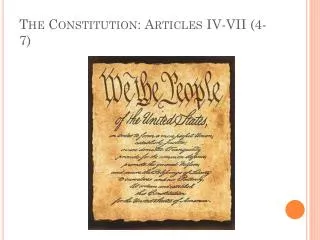
This summary highlights Articles IV through VII of the U.S. Constitution. Article IV focuses on the relationships between states, ensuring that laws and legal statuses (e.g., marriage) are recognized across state lines. It outlines the treatment of citizens, the return of fugitives, and the admission of new states. Article V details the process for amending the Constitution, requiring supermajorities from Congress and state legislatures. Article VI establishes the Constitution as the supreme law and mandates loyalty oaths for federal officers. Article VII defines the ratification process for the Constitution.

E N D
Article IV (4) • Concerns the States • All states will honor the laws of other states. • If you get married in one state you are considered married in another. Convicted of a crime in one state you are still guilty in another, etc. • Citizens in each state are treated equally. • Criminals must be returned if they flee to another state. • New states can be admitted (with some qualifications) • Ensures a republican government for all states. • Ensures the government will protect the states against invasions and insurrections.
Article V (5) • Concerns Amending the Constitution (adding things to the Constitution or changing things). • Proposed by 2/3rds of both houses or by a national convention. • 3/4ths of the states must agree. • Examples (banning alcohol, allowing women to vote, giving slaves freedom).
Article VI • Concerns the United States itself • Government will assume all debts entered into by the U.S. under the Articles of Confederation. • Says the Constitution and all treaties of the U.S. are the supreme law of the country. • Requires all officers of the U.S. to swear an oath of allegiance to the U.S. and the Constitution when taking office.
Article VII (7) • Details the method for ratification of the Constitution (making the Constitution law). • Nine of the thirteen states had to accept it before it could go into effect. • This would lead to problems!