Download
1 / 2
20 likes | 143 Vues
This article engages with the complexities of land claim settlements, critically examining power-sharing dynamics, the stability of accommodation structures, and the achievement of genuine mutual respect between Indigenous and non-Indigenous stakeholders. By analyzing the concept of the 'New Paradigm' in contrast to colonial frameworks, it evaluates whether settlements honor foundational principles of mutual recognition, responsibility, and capacity building. The paper also questions the adequacy of resources and legitimacy within these agreements, emphasizing the need for an ongoing relationship grounded in traditional knowledge and fair practices.

E N D
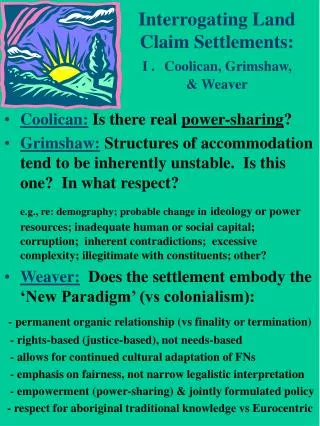
Interrogating Land Claim Settlements: I .Coolican, Grimshaw, & Weaver • Coolican: Is there real power-sharing? • Grimshaw: Structures of accommodation tend to be inherently unstable. Is this one? In what respect? e.g., re: demography; probable change inideology or power resources; inadequate human or social capital; corruption; inherent contradictions; excessive complexity; illegitimate with constituents; other? • Weaver: Does the settlement embody the ‘New Paradigm’ (vs colonialism): - permanent organic relationship (vs finality or termination) - rights-based (justice-based), not needs-based - allows for continued cultural adaptation of FNs - emphasis on fairness, not narrow legalistic interpretation - empowerment (power-sharing) & jointly formulated policy - respect for aboriginal traditional knowledge vs Eurocentric
Interrogating Land Claim Settlements:II. RCAP A. Does the settlement honour RCAP’s ‘Basic Principles’ of a Renewed Relationship? (Vol 1, p. 675-91)Mutual Recognition Mutual Respect Sharing Mutual Responsibility B. Does the Settlement Provide Adequately for Capacity-Building? - to set up govts; to negotiate new intergovt’l arrangements; to exercise govt’l powers over the long term C. Does the Settlement Buttress Legitimacy D. Is the Settlement Adequately Resourced? E. Adequecacy of Transition Provisions?