Understanding Soil Texture: Its Importance and Implications for Agriculture and Construction
Soil texture plays a crucial role in determining the physical properties of soil, such as porosity and density. Composition of sand, silt, and clay affects soil structure, nutrient retention, and water permeability, which are essential for plant growth and agricultural practices. The infamous Teton Dam failure highlighted how choosing inappropriate materials, like silt over clay, can have catastrophic consequences. Understanding the balance of soil components and their impact on root penetration, water flow, and microbial activity is vital for sustainable management of soil resources.

Understanding Soil Texture: Its Importance and Implications for Agriculture and Construction
E N D
Presentation Transcript
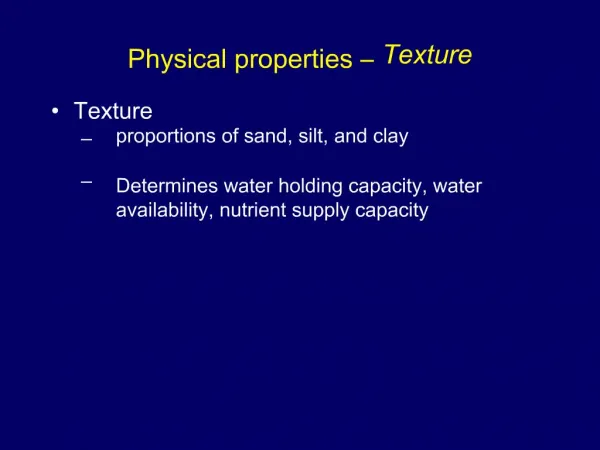
1. Physical properties – Texture Texture
2. Soil Texture Proportions of sand, silt, and clay
Not OM – nonetheless important
Not coarse fragments – nonetheless important Cons: Don’t add pore space, get in the way (plant roots, for example)
Pros: Mineral soil source, rocky soils can allow deep percolation ?water source for deep rooted plantsCons: Don’t add pore space, get in the way (plant roots, for example)
Pros: Mineral soil source, rocky soils can allow deep percolation ?water source for deep rooted plants
3. Relative Size Comparison of Soil Particles
5. Texture Surface area per unit volume
1 g sand ~ 0.1 m2
1 g silt ~ 1 m2
1 g clay ~ 10-1000 m2
6. Teton Dam failure story: used silt instead of clay as dam’s core, and it failed, killing 11 people and wiping out thousands of homes.Teton Dam failure story: used silt instead of clay as dam’s core, and it failed, killing 11 people and wiping out thousands of homes.
8. Influence of Texture
9. Physical properties Density
Porosity
10. But soil properties greatly influenced by –
Pore size range ? Particle heterogeneity
& Aggregation
Finer pores – water unavailable, poor aeration, little waterflow,
Finest pores – too small for microbes
Pore network ? Aggregation
11.
Aggregation influenced by
Coarse scale – biotic:
Roots, Burrowing animals (mammals, earthworms)
Sticky networks: root hairs, fungi
Fine scale – physical/chemical:
Clay properties: Flocculation, bridging (multivalent cations)
Clay/humus/cation complexes
Cementing: Iron oxides (Ultisols & Oxisols)
Volume changes in clays: shrink/swelling, freeze drying