Understanding Physical Properties of Matter: An Overview of Key Concepts
This text explores the fundamental physical properties of matter, such as magnetism, physical state, mass, buoyancy, solubility, conduction, and insulation. It highlights how these properties can be observed, measured, and altered without changing the substance itself. Key concepts include the attraction of magnetic materials, different states of matter (liquid, solid, gas), distinctions between mass and weight, and the principles of buoyancy. Additionally, it delves into solubility in water and the differences between conductors and insulators, emphasizing their practical implications.

Understanding Physical Properties of Matter: An Overview of Key Concepts
E N D
Presentation Transcript
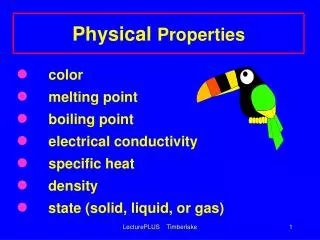
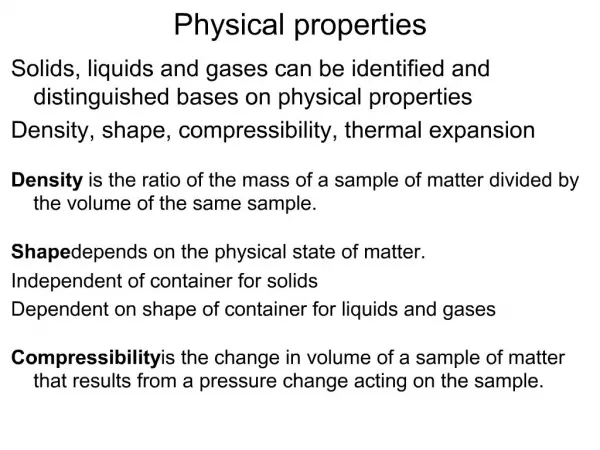
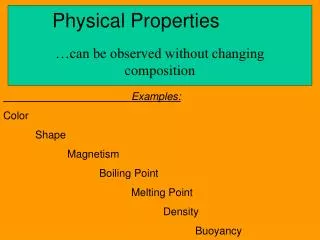
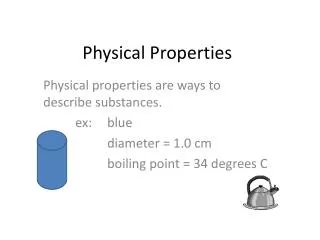
Physical Properties A property than can be observed, measured, or changed without changing the substance itself
Magnetism • Matter that contains iron or nickel will be attracted to a magnet. • Not all metals are attracted to a magnet.
Physical State • Three forms: liquid, solid, or gas • Can change from one form to another by the processes of melting, freezing, evaporation, and condensation • Temperature changes are involved with changes in state.
Mass • Mass is the amount of matter in an object. Mass is measured with a balance. • Mass is not the same as weight. • Weight is a result of the pull of gravity on an object and is measured with a scale.
Buoyancy Floating • The upward push of a liquid or gas on an object.
Relative DensitySinking & Floating • Weight doesn’t determine if an object will sink or float. • The volume of an object and how much “stuff” (matter) is in the object will determine the density.
Solubility in Water • Ability of a substance to dissolve when added to water • A liquid, solid, or gas can be dissolved in water. Examples may include lemon juice in water, sugar in tea, and the carbonation in a soda.
Conduction • Some materials allow thermal (heat) or electrical energy to flow through them easily. • These materials are called conductors.
Insulation • Some materials do not allow thermal (heat) energy or electrical energy to flow through them easily. • These materials are called insulators.
Does it Matter? • Matter has properties that can be observed and measured. • These properties determinehow matter is • classified • changed • or used