SlideServe
Menu
Préférences
© SlideServe · v2026

Frog Dissection Tools and Techniques Guide

barrientes avatar
30 diapositives · 378 Views · Jan 03, 2020

Learn how to dissect a frog step-by-step with detailed external and internal anatomy explanations. Explore functions of the body parts and systems of a frog.
Frog Dissection Tools and Techniques Guide - slide 1
01 / 30Frog Dissection Tools and Techniques Guide
1 / 17

Télécharger la présentation

Frog Dissection Tools and Techniques Guide
Une image / un lien ci-dessous est fourni (tel quel) pour télécharger la présentation

Politique de téléchargement : le contenu du site vous est fourni TEL QUEL pour votre information et votre usage personnel ; il ne peut être vendu, concédé sous licence ni partagé sur d’autres sites sans l’accord de son auteur.Le contenu vous est fourni TEL QUEL, pour votre information et votre usage personnel uniquement. Téléchargez la présentation en cliquant sur ce lien. Lors du téléchargement, si vous ne parvenez pas à télécharger une présentation, l’éditeur a peut-être supprimé le fichier de son serveur.Pendant le téléchargement, si vous ne parvenez pas à obtenir une présentation, le fichier a peut-être été supprimé par l’éditeur.

F I N

Plus de contenu associé

Transcription de la présentation
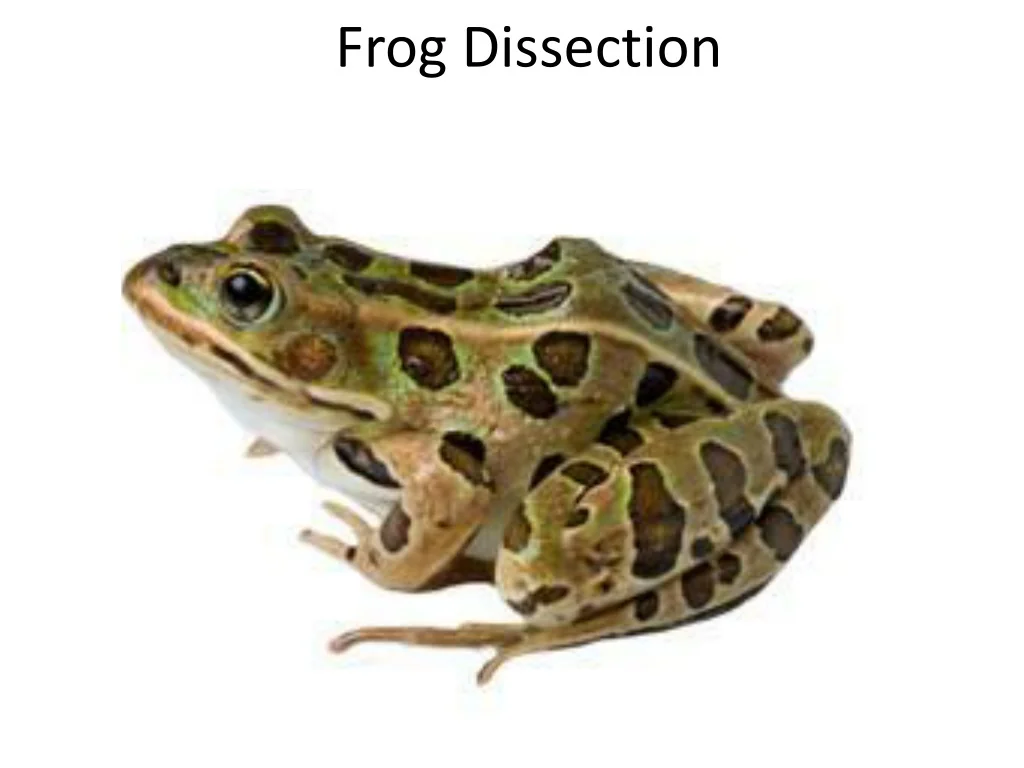
  1. Frog Dissection

  2. Tools • A dissecting tray • A frog • Scalpel • Forceps • Scissors • Pins

  3. Terminology Dorsal • Dorsal-on or relating to the upper side or back of an animal • Ventral-on or relating to the underside of an animal (opposite of dorsal) • Posterior-on or near the behind or back • Anterior-near the front or the head Posterior Anterior Ventral

  4. External Anatomy of the Frog

  5. External Anatomy of the Frog

  6. Determine if your frog is a Male or Female The sex of a frog may be determined externally by examining the thumb pads on the front feet. The thumb pads of males are enlarged at the base as in the drawing on the right.

  7. External Anatomy of the Frog’s Head Nictating Membrane Frontal Membrane Tympanic Membrane External Nares

  8. Nictating Membrane

  9. Internal Anatomy of the Frog’s Head Internal Nares Maxillary Teeth Esophagus VomerineTeeth Glottis Tongue Eustachian tube opening

  10. Functions of the body parts that make up the frog’s head • External nares or nostrils - Anterior openings for the entry or exit of air. • Esophagus - Tube that connects the mouth and the stomach in a frog. • Tympanic Membrane - The eardrum - receives sound waves • Glottis - The opening from the mouth into the respiratory system

  11. Functions of the body parts that make up the frog’s head • Tongue - Muscular structure attached to the front of the mouth which is extended to catch insects (its food). • Maxillary Teeth - Sharp teeth in the maxilla of a frogs mouth that function in holding captured prey. • Vomerine Teeth - Small projections in the top of a frog’s mouth that function in holding and captured prey. • Eustachian tube openings - Openings in the mouth that lead to tubes that connect to the middle ear to equalize air pressure

  12. Functions of the External Anatomy of the Frog • Nictitating Membrane - A transparent part of a frog’s lower eyelid that moves over the eye to clean it and protect it. • Cloacal Opening - Opening of cloaca through which undigested food, urine, eggs, and sperm are passed.

  13. Internal Anatomy

  14. Functions of the Internal Anatomy of a Frog: • Stomach - Stores food and mixes it with enzymes to begin digestion. • Small Intestine - The principal organ of digestion and absorption of digested food. • Duodenum - The anterior (front) part of the small intestine into which food passes from the stomach • Pancreas - Gland which secretes digestive enzymes into the duodenum. • Gall Bladder - Sac which stores bile.

  15. Functions of the Internal Anatomy of a Frog: • Large Intestine - Posterior organ of the digestive system which stores undigested food. • Liver - Secretes bile and processes digested food molecules • Urinary Bladder - The organ that collects and stores urine until released. • Fat Bodies - Masses of fat in the body cavities of frogs.  Needed for hibernating and mating • Spleen - Organ in the frog’s circulatory system that makes, stores, and destroys blood cells. • Cloaca - Organ through which the products of the frogs digestive and urogenital system pass when discharged from the body.

  16. Digestive System

  17. Small Intestines Liver

  18. Respiratory System

  19. Circulatory System

  20. Anatomy of a Frog Heart

  21. Functions of the Frog Heart • Heart - Pumping organ of the circulatory system (has 3 chambers). • Anterior Vena Cava - Large vein that carries blood from the anterior part of the body toward the heart. • Posterior Vena Cava - Large vein that carries blood from the posterior part of the body towards the heart. • Sinus Venosus - Sac that receives blood from the vena cava

  22. Functions of the Frog Heart • Right Atrium - Chamber of the frogs heart which receives blood from the sinus venosus. • Left Atrium - The chamber of the heart that receives blood from the lungs. • Pulmonary Veins - The blood vessels that carry blood form the lungs to the left atrium. • Ventricle - Chamber of a frog’s heart that pumps blood out of the heart to the lungs and other parts of the body. • Truncus Arteriosis - Large artery in a frog that carries blood away from the ventricle into branches that lead to all parts of the body.

  23. Urinary System

  24. Frog Brain

  25. Functions of the Frog Brain • Spinal Cord - Main pathway to and from the brain • Spinal Nerves - Nerves that lead to and from the spinal cord • Olfactory Lobe - Part of the frog’s brain associated with the sense of smell • Cerebrum - Part of the brain that is associated with memory, pain, and voluntary muscle control. • Optic Lobes - Part of the brain associated with vision.

  26. Functions of the Frog Brain • Cerebellum - Part of a brain that influences balance and equilibrium. • Medulla Oblongata - Part of a brain that is the center for some involuntary functions. • Cranial Nerves - Nerves that lead to and from the brain.

  27. Frog Reproductive System

  28. Frog Reproductive System Functions • Urinary Ducts - Tubes in a frog that carry urine from the kidneys to the cloaca • Urinary Bladder - The organ that collects and stores urine until released. • Adrenal Glands - Organs located near the kidneys which secrete hormones. • Ova or Eggs - Female sex cell or gametes

  29. Frog Reproductive System Functions • Ovaries - Organs of the female reproductive system that produce the eggs. • Oviducts - Tubes of a female frog’s reproductive system that carry eggs from the ovaries to the cloaca. • Testes - Male sex organs that produce sex cells (sperm). • Sperm - Male sex cell or gametes. • Seminal Vesicles - Enlarged distal sections of the male frog’s urinary ducts that collect sperm prior to entry into the cloaca.