Unveiling Earth's Atmosphere: Layers, Gases, and Discoveries
140 likes | 237 Vues
Explore the intricate layers of Earth's atmosphere, from the Troposphere to the Exosphere, and discover the composition of the air we breathe. Learn about the significance of each layer, including the ionosphere, and fascinating historical discoveries like the Marconi radio signal bounce in 1901.


Unveiling Earth's Atmosphere: Layers, Gases, and Discoveries
E N D
Presentation Transcript
Earth’s Atmosphere What’s Up There? Image Source: www.NASA.gov
The atmosphere is a layer of gasses that surrounds our planet 90% of its mass is within about 11 km (6 mi) of the surface The atmosphere is very thin compared to the size of Earth Image Source: www.NASA.gov Image Source: NASA
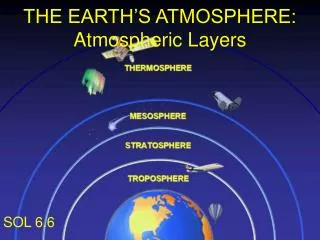
Exosphere Thermosphere Mesosphere Stratosphere Troposphere The Atmosphere is Layered 600Km 85 Km Altitude 50 Km 8-14.5 Km Image Source: www.NASA.gov
(Neutral) Thermosphere Mesosphere Stratosphere Troposphere (Charged) F Layer E Layer D Layer Atmosphere Ionosphere Image Source: www.NASA.gov
Neutral layers commonly defined by: Changes inTemperature Image Source: www.srh.NOAA.gov
What’s in the Air we Breathe? • 78% Nitrogen (N2) • 21% Oxygen (O2) • 1% Other • Water (H2O) • Argon (Ar) • Carbon Dioxide (CO2) • Neon (N) • Helium (He) • Methane (CH4) • Hydrogen (H) • Nitrous Oxide (N2O) • Ozone (O3) other O2 N2
Troposphere (0 - 15 km) • Weather happens here • Thinnest at poles, thickest at equator • 90% of mass found here • Warmed by radiation from Earth • As you go up: • Temperature drops • Pressure drops Image Source: www.Public-Domain-Photos.com
Stratosphere (15 – 50 km) • Contains the ozone (O3) layer • Absorbs harmful ultraviolet radiation (UVC and many UVB rays) • As you go up: • Temperature increases (ozone layer causes this) • Pressure drops • Dry
Mesosphere (50 – 85 km) • Coldest layer (coldest place on the planet!) • As you go up: • Temperature drops • Pressure drops • Meteors burn up here Image Source: www.NASA.gov
Thermosphere (85 – 600 km) • Very few molecules • Incoming solar energy readily absorbed • As you go up: • Temperature increases • Pressure drops • Space shuttle, International Space Station and commercial satellites orbit here • Same altitude as most of Ionosphere; auroras occur here Image Source: www.NASA.gov
Exosphere (600+ km) • Atoms and molecules escape into space • 5x1025 molecules lost every second (That’s 50,000,000,000,000,000,000,000,000!)Don’t worry: atmosphere should last several more billion years • Upper limit not well defined Image Source: Hubblesite.org
Ionosphere • Region of charged ions (positive) and electrons within Thermosphere. Ionosphere represents only about 2% of Thermosphere. • Electrons are torn off atoms by sunlight of short wavelengths (called ionization) • Electrons don’t recombine easily because the distance between molecules is large at high altitudes and collisions are not frequent
Ionosphere Discovery In 1901 Marconi received a radio signal from North America in Europe. It must have bounced off something in the atmosphere, otherwise it couldn’t have reached around the curve of the earth! Image Source: oceanservice.noaa.gov