Understanding Motion: Concepts of Distance, Displacement, and Speed Measurement
This comprehensive guide explores the fundamental concepts of motion, including definitions of movement, distance, and displacement, all relative to a reference point. Learn how to measure distances and calculate speed using formulas, such as Speed = Distance/Time. Through practical examples, like determining the speed of a car or an elevator, and engaging lab exercises, this resource enhances your understanding of constant versus changing speed. Dive into various activities to quantify your speed and acceleration while walking, enriching your grasp of motion principles.

Understanding Motion: Concepts of Distance, Displacement, and Speed Measurement
E N D
Presentation Transcript
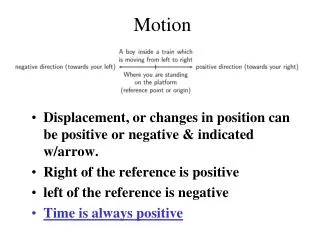
What is Motion? any physical movement or change in position or place, relative to a reference point Movement Reference Point
Distance = how far an object has moved. Measured in meters, kilometers (cm or mm) If each mark represents 10 cm, what is the distance between the girl and the ball? ______ Y Axis X Axis
If the girl walks to the red ball, then walks backwards to the bear, how far has she traveled? ______ Y Axis X Axis Displacement = the distance of a body's change in position from a starting point. Her final displacement is ______ from the starting point.
Speed = the distance an object travels per unit of time (sec, hour, year..etc) Speed Equation Speed (meters/second) = distance (in meters) time (sec) s = d t
A car travels a distance of 500 m in 10 sec. What is the car's speed? s = d/t A second car travels a distance of 100 meters in 20 seconds. What is this car's speed?
More practice. (Speed = distance/ time) An elevator travels from the first floor to the 25th floor of a building, a distance of 100 meters, in 30 seconds. What is the elevator's speed? Distance = ______ Time = _______ Speed = _______
Constant Speed vs Changing Speed Constant speed means that the speed stays the same throughout the entire distance *Very few things can stay at a constant speed. Rather, things usually move at a constant speed for a period of time. The cyclist speeds up, slows down, stops..etc
Speed and the Two-Step Objective: In this lab, you will measure and graph your speed and acceleration as you walk from one point to another. Step 1: Marking Your Space. Step 2: Speed of a Shuffle Step 3: Speed of a Heel-to-Toe Walk Step 4: Normal Walk Switch partners and time again….