HUMAN GENOME COPY in red
Genetic Research Do you recognize each of
these organisms? Why are
they important to
geneticists?
These organisms
represent a group known
as “model organisms.” By
working with them,
scientists better
understand genetics. Guinea
pigs E. coli Tobacco
mosaic
virus Wheat Baker’s yeast Fruit flies
Studying the human genome Imagine a small library, with only 46 books. The longest of
these books would be 3340 pages, and the shortest 400
pages. The text on the page would be a normal size and
there are not any pictures. Now, shrink that library down so it
would fit inside the nucleus of a cell. That is the amount of
information found in the human genome. Do humans have the largest “library?” Not even
close. The marbled lungfish has 130 000 000
000 base pairs in its genome. Humans? Just 3
200 000 000.
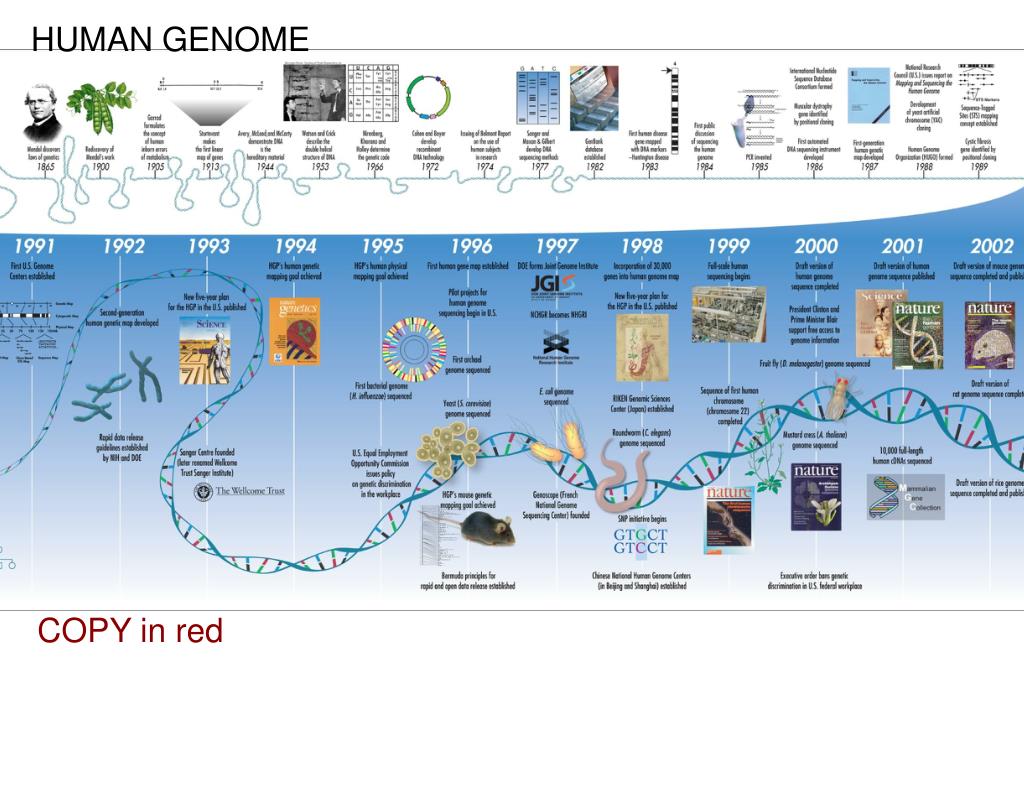
Dissecting Genomes A genome is the full DNA sequence of an organism. The smallest human chromosome contains 5 million base pairs. In 1990, the Human Genome Project starting mapping the entire human
genome with two goals in mind: To determine the nucleotide sequence of all the DNA in human
chromosomes To identify the location and sequence of every human gene The project explored gene functions, studied variations among human DNA,
and compared human DNA to other species. The Human Genome Project was completed in 2003.
Some Completed Genomes
Model Organisms Comparing genes and sequences can reveal insights about different
species. The human Parkinson’s disease gene is similar to a gene for the sense of
smell in rats, and a gene for learning songs in a species of finch. These discoveries can lead to therapies and potential cures. Functional genomics studies the genes of model organisms. By understanding specific genes in these organisms, the human genome
can also be better understood. Agricultural and plant genomes can reveal potential improvements for food and
medicine. The most important aspect of current research is to understand how genes
and proteins work together to create organisms.
This research has allowed us to identify the locations and functions of human genes and to further
our understanding of genetic disorders Genetic Engineering The human population on Earth continues to
increase, and somehow everyone needs to eat. How we grow and obtain our food has changed
drastically over the past 100 years. Today, large agricultural processes that utilize
genetic engineering and biological engineering are
managing to keep up with feeding most of the
world. It is estimated that more than half of what
we eat has been genetically modified in some way. Molecular biologists have only been working with
genetics at the molecular level for the past 30 years,
yet their results have saved millions of lives, and
have changed many industrial processes. How are all
of these changes possible using the simple building
blocks of life? Genetically modified foods
Genetic Engineering - intentionally producing new genes and altering genomes by substituting or introducing new genetic material - in the technique called recombinant DNA, combines genes from different sources, even different species, into a single DNA - the organism most used is a simple bacterium (reproduces every 45 minutes)
Genetic Engineering 1. What is one way that recombinant DNA technology can
benefit farmers? 2. How can recombinant DNA technology be used to treat
diabetes? Questions Biotechnology refers to using living
things to help humans produce
useful products. This has occurred
for thousands of years in our
agricultural practices, especially in
the breeding of useful organisms. In our modern world, there are a
multitude of examples of using
biotechnology. Try the activity on
right to learn about some uses you
may not have known. Once you
have finished the activity, please
answer the questions found on the tab to the left. 1. What is one way that recombinant DNA technology can
benefit farmers? Recombinant DNA technology has been used to develop
tomatoes that ripen slowly and corn that is resistant to
herbicides. 2. How can recombinant DNA technology be used to treat
diabetes? The human gene for producing insulin has been inserted
into bacterial DNA. The bacteria reproduce quickly,
producing much more insulin than other methods. Insulin is
used by diabetics to control the levels of sugar in their
blood. Answers
Genetic Engineering Genetic recombination Genetic engineering is a branch of
biotechnology that involves the
manipulation of the actual genetic
material of useful organisms. By
changing or adding genes, useful traits
can be added, and detrimental traits can
be removed. Soon, an entire genome could be stitched together from pieces of
genetic material. Until that fateful day, we will continue to use technologies such as genetic
recombination, where sections from one
genetic source are added to another. Watch how genetic recombination works
in the animation on the right.
Individual genes, or an entire genome, can be cloned. Cloning Cloning can refer to making copies of DNA
fragments, cells, or entire organisms. Dolly the sheep (1997) was the first successful
mammal clone. Many other mammals have been clones in the
years since. Nuclear transplantation is one method used in animal cloning. The nucleus from an adult cell replaces the
nucleus in an egg. If the egg begins to develop into an embryo, it
is implanted into a host.
Gene Therapy Gene therapy is used to treat genetic afflictions. A gene is enhanced or replaced to treat a medical condition. This allows the body to produce the missing protein that causes the
condition by using the therapeutic gene. It can be challenging to get the fixed gene to the proper location. Viruses are sometimes used to carry and insert the gene. Cell and tissue transplants, microscopic injections, and aerosol inhalers
are also used. Gene therapies are being developed that may help treat Huntington’s
disease, skin cancer, cystic fibrosis, and more. Testing is difficult and time consuming; challenges include successfully
delivering the new genes and long term success.
Gene Therapy
Genetically Modified Organisms Scientists have already created many useful organisms in their
laboratories. The bacteria C. crescentus naturally creates a biofilm to cover solid
objects, and has been modified to absorb heavy metals. This bacterium could be used to clean lake water. While these genetically modified organisms (GMOs) could help, they would
also have unknown consequences. A GMO is any organism that has
genetically engineered materials. Transgenic organisms have
genetic material from other
species. GMOs have a wide range of
applications in agriculture and
medicine. GloFish, gentically engineered fish with
fluorescent jellyfish DNA, were one of
the first GMOs for sale to the public as
pets.
Producing Genetically Modified Plants Pest resistant GM crops integrate genes from (bacteria) Bacillus thuringiensis, producing a toxin that kills insect pests. These GM crops do not require spraying with pesticides. Other traits biologically engineered into crop plants include resistance to
herbicides and viral infections. GM plants are often used as “factories” to produce desirable materials such
as pharmaceuticals, industrial products, and biofuels. Transgenic safflower plants can produce human insulin for diabetics to use,
replacing the difficult to refine insulin currently produced by transgenic yeast
and bacteria. GM plants can lower production costs and increase yields.
Producing Genetically Modified Animals Recombinant DNA is used extensively to produce vaccines and growth
hormones for farm animals. These animals themselves can become GMOs as well. Animals are more difficult to bioengineer, as their development is much
different from plants. During in vitro fertilization, an egg is
fertilized outside of the female, the
desired gene is injected into the
developing embryo, and it is then
implanted into the mother to develop. It can take many attempts before the
fertilized egg will accept DNA. Success rates are much lower than
with plants. The first successful human in vitro
fertilization (IVF) occurred in England in
1977. Early IVF offspring were referred
to as “test tube babies.”
Producing Genetically Modified Animals “Pharming” refers to using GMOs to producing pharmaceuticals. In pharming, human genes are added to farm mammal genomes. These genes then produce a particular protein, such as hormone, that is
generally secreted in the animal’s milk. This method is used when
transgenic bacteria or plants
cannot produce the required
protein or substance adequately. Often, the goal of creating GMOs
is the same as traditional
breeding programs; to enhance
traits already present in the
species through selective
breeding. Researchers at the University of Guelph
developed the GMO “EnviroPig”. Enviropig
wastes are much lower in phosphorous
than normal pig wastes.
Regulating the Use of GMOs There are concerns that the use of GMOs could harm consumers or the
environment. What effect will an organism with changed genetic information have when
it interacts with normal members of its species? Will GMOs outcompete normal individuals? Will GMOs pass along their genetic changes if they successfully mate with
wild organisms? Could engineered genetic traits, such as pesticide resistance, spread to
other species through viral transfer? Who owns organisms with certain engineered traits? Although few health problems have been noted, strict regulations are
usually recommended for GMOs. Testing of medicines and foods must be done to ensure safety.
Regulating the Use of GMOs Governments and agencies around the world are attempting to make
GMOs safe and properly understood. In Canada, evaluators from the Canadian Food Inspection Agency (CFIA)
and Health Canada assess the safety of new agricultural products made
with modern biotechnology. Many countries require any food that has a GMO connection must be labelled as such.
pg. 174 #1~3, 5~13, 15~18, 20
Producing Genetically Modified Plants Recombinant DNA technology can be used to improve the characteristics
of crop plants. Genetically modified (GM) plants have been made to slow ripening,
improve nutrition, tolerate stress, and reduce spoiling. GM plants have replaced traditional breeding practices, especially if the
crop’s important traits are found on few genes. GM plants are easy to
grow, as an entire new
plant can often be grown
from a single adult cell. Transgenic plants are
often created by using the
bacterium Agrobacterium
tumefaciens.