

SlideServe
Menu
Préférences
© SlideServe · v2026

Matrix Structure

bracha avatar
13 diapositives · 798 Views · Sep 14, 2014

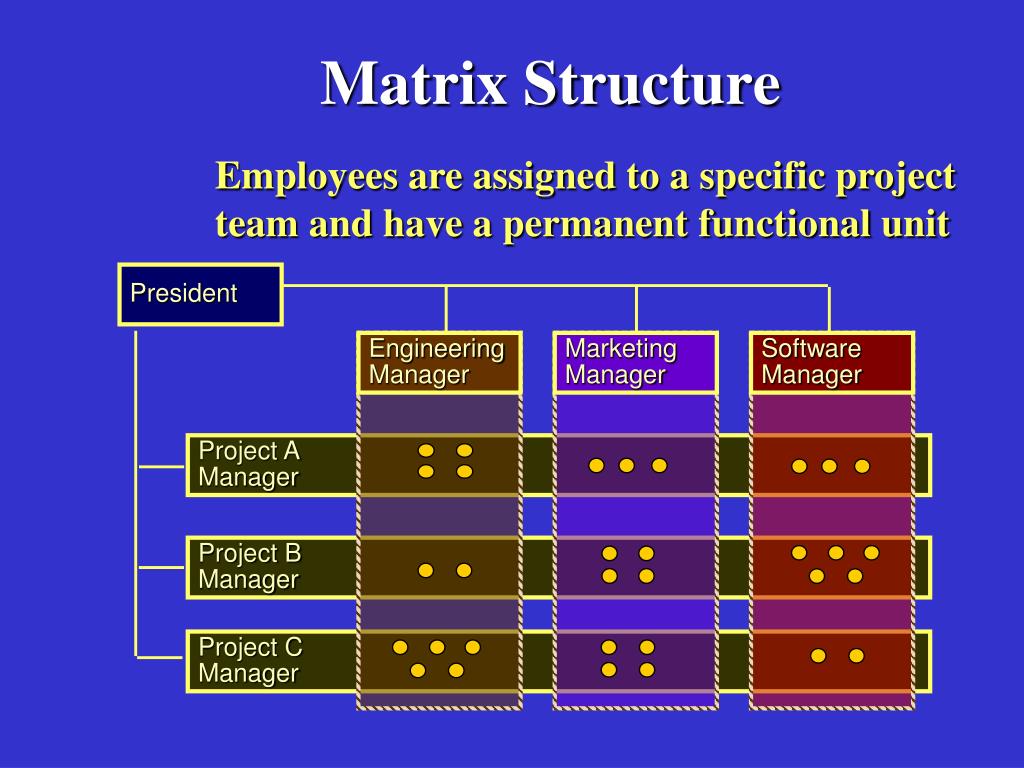
Engineering Manager. Marketing Manager. Software Manager. Matrix Structure. Employees are assigned to a specific project team and have a permanent functional unit. President. Project A Manager. Project B Manager. Project C Manager. Matrix Structure - Why?.
Matrix Structure - slide 1
01 / 13Matrix Structure
1 / 17

Télécharger la présentation

Matrix Structure
Une image / un lien ci-dessous est fourni (tel quel) pour télécharger la présentation

Politique de téléchargement : le contenu du site vous est fourni TEL QUEL pour votre information et votre usage personnel ; il ne peut être vendu, concédé sous licence ni partagé sur d’autres sites sans l’accord de son auteur.Le contenu vous est fourni TEL QUEL, pour votre information et votre usage personnel uniquement. Téléchargez la présentation en cliquant sur ce lien. Lors du téléchargement, si vous ne parvenez pas à télécharger une présentation, l’éditeur a peut-être supprimé le fichier de son serveur.Pendant le téléchargement, si vous ne parvenez pas à obtenir une présentation, le fichier a peut-être été supprimé par l’éditeur.

F I N

Plus de contenu associé

Transcription de la présentation
  1. Engineering Manager Marketing Manager Software Manager Matrix Structure Employees are assigned to a specific project team and have a permanent functional unit President Project A Manager Project B Manager Project C Manager

  2. Matrix Structure - Why? • To get the advantages of two structures (e.g., Functional for high specialization and Product for decentralized decision making) • Often used with sophisticated technology, fast-changing environment • Geographic and Product often combined in Multi-national firms

  3. Disadvantages of Matrix • Conflict between two sides of matrix • Meetings to coordinate activities • May need extensive human relations training

  4. How do we coordinate across functions? Within a Functional Structure: -Direct Contact (liaisons, integrators) -Temporary Task Forces -Permanent Committees OR Use a structure with inherent cross- functional contact: -Divisional -Matrix -Teams

  5. Organizational (Corporate) Culture • Key values, beliefs, understandings, and norms shared by organization members.

  6. Cultural indicators that can be seen at the surface level Visible Artifacts such as stories, symbols, slogans, ceremonies Invisible Employees are family Customer service at any cost Quality is essential Sales targets are important Deeper values and shared understandings held by organization members.

  7. What Cultures Do • Distinguish organization from others • Generate commitment to the organization • Guide employee behaviors

  8. Types of Cultures There are many classification systems, including those based on: Risk Tolerance Communication Patterns Types of Control Reward Systems

  9. Sources of Culture • Founder • Change Agents • Experience • National, Regional Culture

  10. Cultural Leadership Maintaining/Changing Culture: • Communicate • Reward • Set Examples

  11. Possible Negative Aspects of Culture • Can impede change • May not tolerate diversity of thought • Can prevent successful mergers and acquisitions

  12. Merging Cultures • Bank of America acquired MBNA (2005) • B of A • “No-nonsense, low-cost operator” • Attire: Business Casual • Everyone participated in discussions • MBNA • Opulent headquarters, generous salaries, lavish perks • Attire: Jackets and Ties • Junior employees kept quiet

  13. Merging Cultures • Senior MBNA managers’ pay cut • MBNA Division: Still dressy in corporate offices and in front of clients; business casual in back offices. • B of A became more conscious of “how they look.” • B of A adopted MBNA’s approach of depending less on computerized decisions and more on human judgment in granting credit • Increasing participation in the MBNA division was difficult.