Implementation and Performance Testing of OFDM Receiver on FPGA
This project focuses on the implementation of an OFDM receiver using FPGA technology to enable performance testing and identification of architectural bottlenecks. Guided by Mony Orbach, the team led by Tomer Ben Oz and Ariel Shleifer aims to provide essential tools for future enhancements in OFDM systems. The working environment includes Simulink via MATLAB and Xilinx ISE 12.2, with detailed designs for demodulation and phase shifting. The project emphasizes the importance of practical tests and provides a solid foundation for future developments in communication systems.

Implementation and Performance Testing of OFDM Receiver on FPGA
E N D
Presentation Transcript
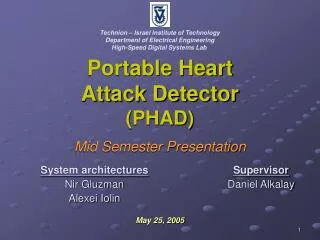
Mid Semester Presentation OFDM implementation and performance test Performed by: Tomer Ben Oz Ariel Shleifer Guided by: MonyOrbach Duration: Semester
motivation • Tera-Santa project in the Technionrequires basic implementation. • FPGA implementation of OFDM receiver will enable basic performance test and identification of architecture bottlenecks.
Project goals • Implementation of an OFDM receiver on FPGA. • Give a good base and tools for future bottlenecks and capability testing.
Working environment • Simulink via Matlab • Xilinx ISE 12.2 • Modelsim
Demodulator Block diagram Phase multiplier – Shifts the phase of the signal back to its original phase. Inputs: Q in, I in – Current sample’s values; A,B – Correction factors • outputs: Q out, I out – The correct signals values.Look Up Table(Qam4) – Translate the signal back to data in bits. • Inputs: Q, I – The correct signals values.outputs: QAM4_OUT – The translated data
Phase Multiplier Block diagram • IQ multiplier– Shifts the phase of the signal back to its original phase. • Inputs: Q in, I in – Current sample’s values; A,B – Correction factors • outputs: Q out, I out – The correct signals values.TDD– Time Domain Demux • Inputs: 8 bits.outputs: D0-3 –each output channels the input data in an upwards order. • TDM– Time Domain mux • Inputs: D0-3 - 8 bits each.outputs: The output channels the input data in an upwards order.
IQ multiplier Block diagram • IQ multiplier– Shifts the phase of the signal back to its original phase. • First degree (multiplication) Delay is 3 cycles • Second degree (adder) Delay is 1 cycle • Hence we chose TDD and TDM to have 4 inputs\outputs
Testing environment XUP5 Dram XC5VLX110T Dram Data In Data out counter counter
Gant Diagram End of Simulations End of Basic Integration End of Basic Design