Understanding Lateral and Surface Area of Cones and Cylinders
This guide explores the characteristics of cones, specifically why they are not classified as polyhedrons due to their curved surface. We calculate the lateral area (LA) and surface area (SA) of cones and cylinders, providing examples with given dimensions. For Cone A, we find the lateral area as 78π cm² and total surface area using the formula SA = LA + πr². We also cover problems involving Cylinder A and Cone B, both with a base radius of 6 cm, where students will apply their understanding to compute lateral and surface areas.

Understanding Lateral and Surface Area of Cones and Cylinders
E N D
Presentation Transcript
Is a cone a polyhedron? • Cone: a solid with one base that is a circle, and a curved, smooth lateral surface that comes to a point, the apex. No, because it has a curved lateral surface area.
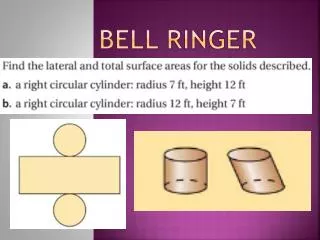
c. LA = ½ (12 π ) (13) LA = 78 π cm² SA = LA + πr² SA = 78 π + 36π Find the lateral and total surface area for the solids described. d. LA = ½ (13 π) (12) LA = 78 π cm² SA = LA + πr² SA = 78 π + 6.5 ² π
Practice Problems Cylinder A has a height of 8cm. Cone B has a slant height of 8cm. Each shape has a base radius of 6 cm. Find the lateral area and surface area of Cylinder A and Cone B.
Homework Finish the worksheet on lateral and surface area.