Download
1 / 17
170 likes | 257 Vues
Explore the utility of FEM and FEA in evaluating heart device designs without the need for physical prototypes. Learn how these tools help save time and money while enhancing experimental capabilities for medical advancements like Arrow LionHeartTM LVADs. Discover insights from a parametric study on Poly(urethaneurea) blood sacs and titanium pump cases, showcasing the impact of design variations. Dive into conclusions on material stresses, strains, and optimization strategies to improve device durability. Stay informed with the latest news on fully implantable heart assist devices like the Arrow LionHeartTM and advancements like the Total Artificial Heart for better patient outcomes.

E N D
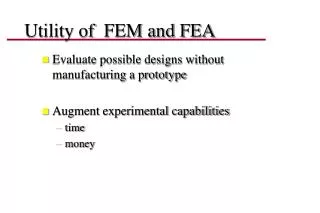
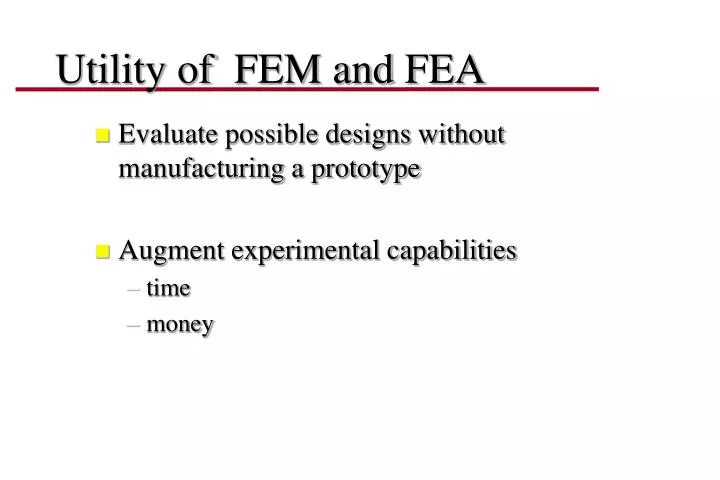
Utility of FEM and FEA • Evaluate possible designs without manufacturing a prototype • Augment experimental capabilities • time • money
Heart Disease • 4 million patients in the U.S. are victims of heart failure, and nearly 400,000 new cases are diagnosed each year • 2,800 receive heart transplants • Heart disease is the leading cause of death and disability in the U.S.
Arrow LionHeartTM • LVAD (Left Ventricular Assist Device) • electric pulsatile blood pump • fully implanted in upper abdomen • 70 cc volume 8 L/min at beat rate of 135 = stroke volume of 60 cc
Introduction Poly(urethaneurea) Blood Sac Pusher- plate Titanium Pump Case
Introduction • Design goal: 2 yrs @50,000,000 cycles/yr = 100,000,000 cycles • FEA used to evaluate various pump designs and their effectiveness at reducing the material stresses
Finite Element Model • Axisymmetric • Pusherplate and pump case treated as rigid • 8-node continuum elements • Blood sac : homogeneous, hyperelastic (non-linear) • Frictionless contact
0.9 in 2.86 in Finite Element Model
Boundary Conditions • Internal pressure = 100 mm Hg • Rigid pump case was fixed in space • Pusherplate displaced 0.8 inches • 30 increments • simulating ejection stroke of pump
Parametric Study • 3 different thickness sacs (0.015, 0.02, 0.025 inches) • 2 pump case designs (tapered, not tapered) • 2 radii of curvature for sac (3/16 and 7/16 inch) • Total of 12 cases
3/16 inch of stroke 3/8 inch of stroke end of stroke
2 3 4 1
Conclusions • Material stresses and strains are sensitive to the thickness of the blood sac • Radius of curvature has little influence on the peak stress in the blood sac, however, it does affect when the peak stress occurs during the stroke cycle
Conclusions • Tapering the pump case can significantly alter blood sac stresses • All stresses and strains were much lower than the yield stress and strain for poly (urethaneurea)
News Release (Feb. 28th, 2001) • First fully implantable heart assist device implanted • As of March 12th, Arrow LionHeartTM recipient is stable and recovering as expected
Total Artificial Heart • Fit into chest cavity • 50 cc • Develop a model to predict and minimize stresses in biomaterials, so that the durability of a reduced-size device is not adversely affected by pump scaling