Introduction to the Periodic Table
210 likes | 330 Vues
Join me, Dmitri Mendeleev, as we explore the fascinating world of the Periodic Table! Learn how it's organized, what atomic number and atomic weight mean, and how to find the number of protons, electrons, and neutrons in an element. We'll also differentiate between elements, compounds, and mixtures, clarifying what makes each unique. With your newfound knowledge, you'll navigate the world of chemistry with confidence — even if you're not quite as handsome as me!


Introduction to the Periodic Table
E N D
Presentation Transcript
Introduction to the Periodic Table Atomic Number ● Symbol ● Atomic Weight Element ● Compound ● Mixture
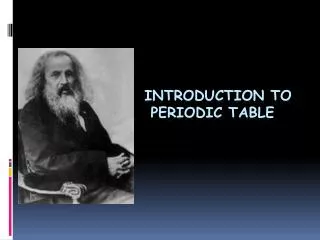
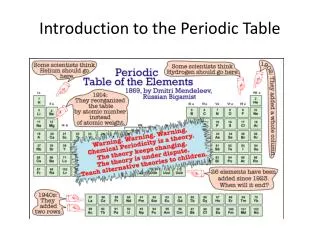
I am Dmitri Mendeleev! I made the PERIODIC TABLE !
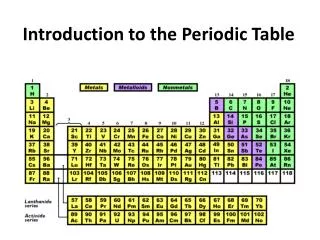
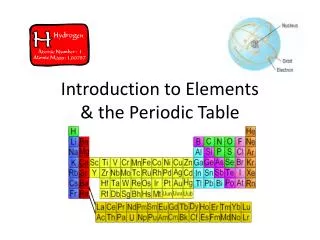
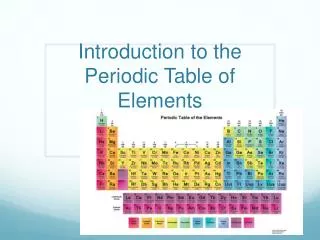
What is the PERIODIC TABLE? • Shows all known elements in the universe. • Organizes the elements by chemical properties.
What is the ATOMIC NUMBER? • The number of protons found in the nucleus of an atom Or • The number of electrons surrounding the nucleus of an atom.
What is the SYMBOL? • An abbreviation of the element name.
What is the ATOMIC WEIGHT? • The number of protons and neutrons in the nucleus of an atom.
How do I find the number of protons, electrons, and neutrons in an element using the periodic table? • # of PROTONS= ATOMIC NUMBER • # of ELECTRONS= ATOMIC NUMBER • # of NEUTRONS= ATOMIC _ ATOMIC WEIGHT NUMBER
Now you are almost as smart as I am! But not as handsome! Man, I look GOOD!
What is an ELEMENT? • A substance composed of a single kind of atom. • Cannot be broken down into another substance by chemical or physical means.
What is a COMPOUND? • A substance in which two or more different elements are CHEMICALLY bonded together.
What is a MIXTURE? • Two or more substances that are mixed together but are NOT chemically bonded.
You are still not as handsome as the great Mendeleev! I am working this beard! Man, I look GOOD!