Download
1 / 9
90 likes | 199 Vues
This presentation discusses the developments in high-resolution data assimilation and weather forecasting, focusing on convective dynamics. Presented by Ross Bannister and Stefano Migliorini from NCEO, alongside Mark Dixon from ex-MetO, it outlines the use of the MOGREPS ensemble system adapted to 1.5 km resolution over the Southern UK. Topics include the significance of geostrophic and hydrostatic balance at different scales, the need for accurate forecast error statistics, and the importance of variational data assimilation in enhancing probabilistic forecasting. This research aims to better model convective-scale forecast errors.

E N D
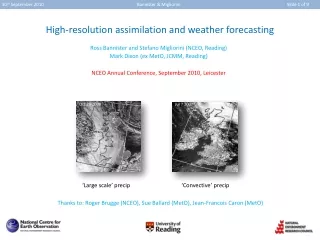
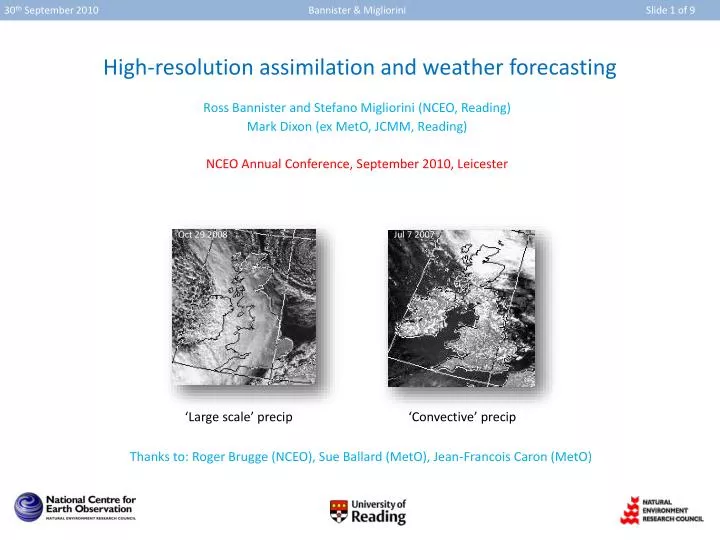
High-resolution assimilation and weather forecasting • Ross Bannister and Stefano Migliorini (NCEO, Reading) • Mark Dixon (ex MetO, JCMM, Reading) • NCEO Annual Conference, September 2010, Leicester Oct 29 2008 Jul 7 2007 ‘Large scale’ precip ‘Convective’ precip Thanks to: Roger Brugge (NCEO), Sue Ballard (MetO), Jean-Francois Caron (MetO)
Resolution of atmospheric models SUK-1.5 Met Office / 1.5km convective scale 1-10 km meso-scale 100 km synoptic scale 1000 km 1.5 km 4 km 12km 20 km (N640) 25 km (N512) 40km (N320) 60 km (N216) 90 km (N144) 120 km (N108) 135 km (N96) 270 km (N48) (c) MeteoFrance
Aims • To develop a system to • deal appropriately with convective dynamics in a variational data assimilation system, • use available high-resolution observations, • make probabilistic forecasts. • Background • A variational data assimilation system should respect the dynamics of the problem, even for 3d-Var. Why? Background error PDF observations model observations observation operator ‹xB› ‘model space’ ‘observation space’
What is the measured ‘shape’ of the background error PDF at high-resolution? Use the MOGREPS* ensemble system, adapted to 1.5 km resolution over the Southern UK 1 hour 1 hour 1 hour control forecast (preliminary 3D-VAR + nudging) 23 perturbations (updated with ETKF†) time Calculate covariance and correlation diagnostics with no attempt to overcome rank deficiency Pf = <(xi - ‹xi›) (xi - ‹xi›)T> ‹ › = ensemble mean * MOGREPS: Met Office Global and Regional Ensemble Prediction System † ETKF: Ensemble Transform Kalman Filter
Forecast error covariance diagnostics Can 24 states (control forecast + 23 perturbations) give meaningful statistics? At what scales can geostrophic effects be ignored? When does hydrostatic balance break-down? The answers to these questions will help to develop a new error covariance model for convective scales.
(I) Relevance of geostrophic balance FORECASET ENSEMBLE DIAGNOSTICS PERFECT GEOSTROPHIC BALANCE geostrophic u response u correlation with p at × geostrophic v response v correlation with p at × geostrophically unbalanced geostrophically balanced tropopause near ground mid-troposphere
(II) Relevance of hydrostatic balance FORECASET ENSEMBLE DIAGNOSTICS PERFECT HYDROSTATIC BALANCE T correlation with p at × Hydrostatic T response hydrostatically unbalanced ? hydrostatically balanced
Summary • Data assimilation needs information about the forecast error statistics. • The variational assimilation approach needs a model of how components of forecast error are correlated (need to reflect the right physics of the system). • Have adapted the Met Office MOGREPS system to work at high-resolution. • Useful for probabilistic forecasting. • Useful to investigate forecast error covariances. • Have found that: • geostrophic balance diminishes at horizontal scales smaller than about 75 km; • hydrostatic balance diminishes at horizontal scales smaller than about 20 km, especially within convection (Vetra-Carvalho et al.). • Next stage. • Improve representation by including other sources of forecast error • Propose a model of convective-scale forecast error covariances.