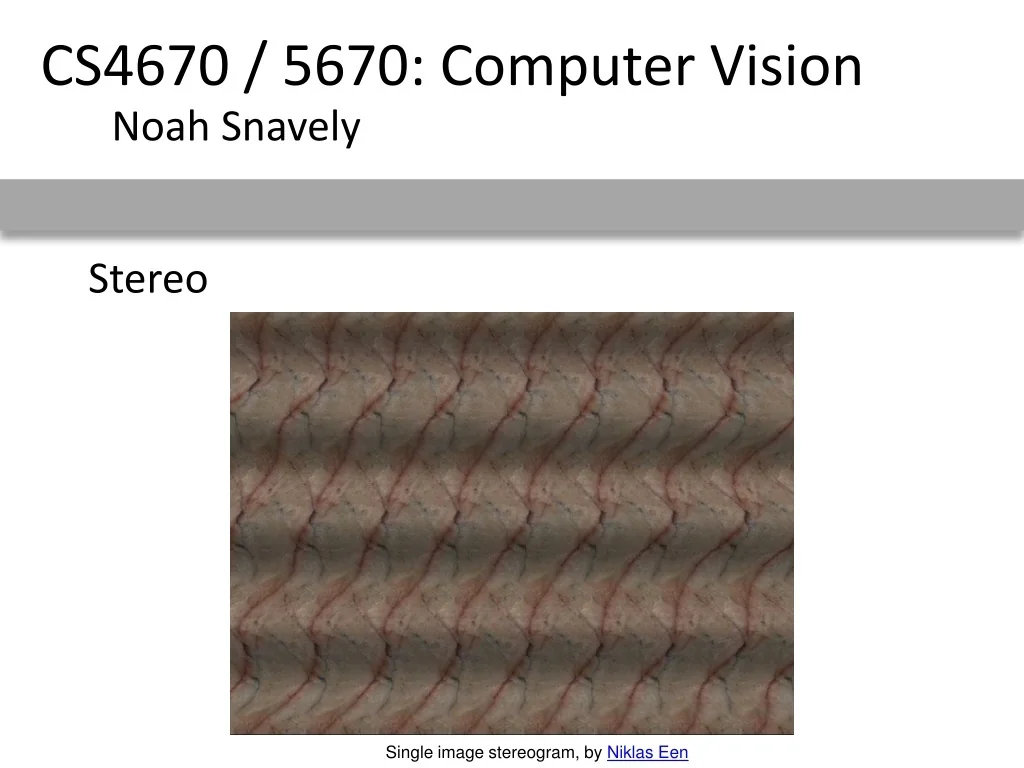
CS4670 / 5670: Computer Vision Noah Snavely Stereo Single image stereogram, by Niklas Een
Mark Twain at Pool Table", no date, UCR Museum of Photography
Stereo • Given two images from different viewpoints • How can we compute the depth of each point in the image? • Based on how much each pixel moves between the two images
Epipolar geometry epipolar lines (x2, y1) (x1, y1) Two images captured by a purely horizontal translating camera (rectified stereo pair) x2 -x1 = the disparity of pixel (x1, y1)
Stereo matching algorithms • Match Pixels in Conjugate Epipolar Lines • Assume brightness constancy • This is a tough problem • Numerous approaches • A good survey and evaluation: http://www.middlebury.edu/stereo/
For each epipolar line For each pixel in the left image Improvement: match windows Your basic stereo algorithm • compare with every pixel on same epipolar line in right image • pick pixel with minimum match cost
W = 3 W = 20 Window size • Smaller window • Larger window Effect of window size • Better results with adaptive window • T. Kanade and M. Okutomi,A Stereo Matching Algorithm with an Adaptive Window: Theory and Experiment,, Proc. International Conference on Robotics and Automation, 1991. • D. Scharstein and R. Szeliski. Stereo matching with nonlinear diffusion. International Journal of Computer Vision, 28(2):155-174, July 1998
Stereo results • Data from University of Tsukuba • Similar results on other images without ground truth Scene Ground truth
Results with window search Window-based matching (best window size) Ground truth
Better methods exist... • State of the art method • Boykov et al., Fast Approximate Energy Minimization via Graph Cuts, • International Conference on Computer Vision, September 1999. Ground truth • For the latest and greatest: http://www.middlebury.edu/stereo/
Stereo as energy minimization • What defines a good stereo correspondence? • Match quality • Want each pixel to find a good match in the other image • Smoothness • If two pixels are adjacent, they should (usually) move about the same amount
Stereo as energy minimization • Find disparity map d that minimizes an energy function • Simple pixel / window matching = SSD distance between windows I(x, y) and J(x + d(x,y), y)
Stereo as energy minimization I(x, y) J(x, y) y = 141 d x C(x, y, d); the disparity space image (DSI)
Stereo as energy minimization y = 141 d x Simple pixel / window matching: choose the minimum of each column in the DSI independently:
Stereo as energy minimization • Better objective function { { smoothness cost match cost • Want each pixel to find a good match in the other image • Adjacent pixels should (usually) move about the same amount
Stereo as energy minimization match cost: smoothness cost: : set of neighboring pixels 4-connected neighborhood 8-connected neighborhood
Smoothness cost How do we choose V? L1 distance “Potts model”
Dynamic programming • Can minimize this independently per scanline using dynamic programming (DP) : minimum cost of solution such that d(x,y) = d
Dynamic programming • Finds “smooth” path through DPI from left to right y = 141 d x
Dynamic Programming
Dynamic programming • Can we apply this trick in 2D as well? • No: dx,y-1 and dx-1,y may depend on different values of dx-1,y-1 Slide credit: D. Huttenlocher
Stereo as a minimization problem • The 2D problem has many local minima • Gradient descent doesn’t work well • And a large search space • n x m image w/ k disparities has knmpossible solutions • Finding the global minimum is NP-hard in general • Good approximations exist… we’ll see this soon
Questions?
X z x x’ f f baseline C C’ Depth from disparity
Real-time stereo • Used for robot navigation (and other tasks) • Several software-based real-time stereo techniques have been developed (most based on simple discrete search) • Nomad robot searches for meteorites in Antartica • http://www.frc.ri.cmu.edu/projects/meteorobot/index.html
Stereo reconstruction pipeline • Steps • Calibrate cameras • Rectify images • Compute disparity • Estimate depth • Camera calibration errors • Poor image resolution • Occlusions • Violations of brightness constancy (specular reflections) • Large motions • Low-contrast image regions What will cause errors?
camera 1 camera 1 projector projector camera 2 Active stereo with structured light • Project “structured” light patterns onto the object • simplifies the correspondence problem Li Zhang’s one-shot stereo
Laser scanning • Optical triangulation • Project a single stripe of laser light • Scan it across the surface of the object • This is a very precise version of structured light scanning • Digital Michelangelo Project • http://graphics.stanford.edu/projects/mich/
Laser scanned models • The Digital Michelangelo Project, Levoy et al.
Laser scanned models • The Digital Michelangelo Project, Levoy et al.
Laser scanned models • The Digital Michelangelo Project, Levoy et al.
Laser scanned models • The Digital Michelangelo Project, Levoy et al.