SCIENTIFIC METHOD
The scientific method, developed by Galan in the 2nd century A.D., is a series of steps followed by scientists to solve problems in a systematic and evidence-based manner. This article explains each step of the scientific method and discusses its importance in conducting research and drawing valid conclusions. It also explores different types of research, the role of ethics in scientific decision-making, and the impact of science on society.

SCIENTIFIC METHOD
E N D
Presentation Transcript
Scientific Method • Developed by Galan in 2nd Century A.D. • Series of steps followed by scientists to solve problems
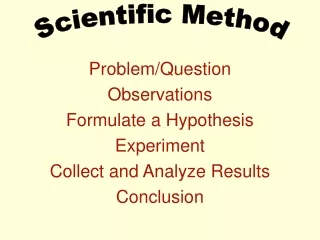
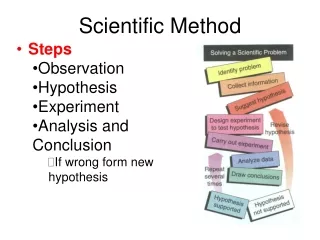
Observation You notice something about the natural world
DEFINE PROBLEM (ask a question) State the problem in the form of a question to be answered
RESEARCH PROBLEM • Making more observations, • Make initial measurements (quantitative) • Collect information from different sources
HYPOTHESIS • Form a hypothesis – an if/then statement. • Make an educated prediction to answer the question • Experiment are performed to test the hypothesis which may be supported or refuted.
EXPERIMENT • Test the hypothesis. • Controlled experiment based on the comparison of a control group and an experimental group • Control: a standard for comparison Other things to consider: • Sample size? • Repetition
VARIABLES • A Variables is any factor that may influence the experiment • Only ONE variable may be tested at a time. • Kinds of Variables : • Constants: stay the same • Independent variable:the manipulated variable (I change) • Dependent variable: the factor that is being measured or controlled during the experiment.
DATA COLLECTION Observe and record data from experiment.
CONCLUSIONS • Draw conclusions by inferring a resolution based on the facts. • Determine whether the hypothesis is supported or refuted.
REPORTING • Accurately report research methods, results and conclusions • Communication methods: • make a presentation, • publish in a journal • share data with other scientists verbally.
THEORY • A hypothesis that is supported byexperimental evidence over a long period of time • Scientific explanations are based on fact and observation not superstition or fiction.
KINDS OF RESEARCH • Pure Science - for sake of knowledge • Applied Science (technology) - research to solve practical problems; practical use of acquire knowledge • Quantitative - numerical involves measuring • Qualitative – descriptive: color, texture etc
SCIENCE AND SOCIETY • Bioethics - the study of what is right and wrong and morality of choices related to biological issues • 1. evolution - creationism vs. evolutionism • 2. genetic engineering - how far can we go? how far should we go? • 3. AIDS - education, prevention, treatment • 4. abortion - as a means of saving a life, a means of contraception • Based on opinion. • Society decides what is considered ethical.