The Beijing Consensus: Setting Standards
This analysis explores the Beijing Consensus, a model characterized by secularized collectivism with Confucian influences, representing a unique path of governance under China’s People's Democratic Dictatorship. The paper discusses how countries from Syria to Vietnam are increasingly drawn to China’s political and economic framework, seeking prosperity without sacrificing power. It highlights the shifting global perception of democracy and examines how the "China model" is gaining traction among nations that aspire for dynamic growth while maintaining authoritarian rule.

The Beijing Consensus: Setting Standards
E N D
Presentation Transcript
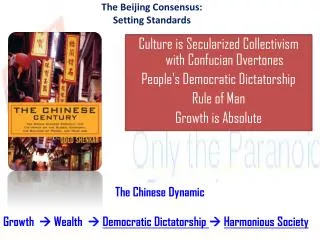
Culture is Secularized Collectivism with Confucian Overtones People's Democratic Dictatorship Rule of Man Growth is Absolute The Beijing Consensus:Setting Standards The Chinese Dynamic Growth Wealth Democratic Dictatorship Harmonious Society
The Beijing Consensus • The Standard of the One-Party CCP • Changing political rhetoric shows fascination with copying China’s authoritarian capitalism. • More and more counties are interested by the Chinese “experience in building a political system dominated by one political party.” • "China model of is gaining currency. Governments from Syria to Vietnam (along with Sudan, Burma, Uzbekistan, North Korea, and Zimbabwe, to name just a few others) have sung its praises." • Prosperity without Relinquishing Power • Democracy’s magnetic allure wanes given the belief of China imitators that they can create a dynamic economy without easing their grip on political power. • Africa Rising • Ideological “Respect” • China refrains from delivering lectures on political freedom and human rights. • Quid Pro Quo