
SlideServe
Menu
Préférences
© SlideServe · v2026

Characters provide basis for classifying

chumani avatar
11 diapositives · 339 Views · Nov 26, 2012

Characters provide basis for classifying. Characters are traditionally phenotypic features (morphology, life cycle, etc.) But now you can also measure genetic sequences directly Homologous characters: similarities attributed to shared ancestry (e.g., mammal forelimbs)
Characters provide basis for classifying - slide 1
01 / 11Characters provide basis for classifying
1 / 17

Télécharger la présentation

Characters provide basis for classifying
Une image / un lien ci-dessous est fourni (tel quel) pour télécharger la présentation

Politique de téléchargement : le contenu du site vous est fourni TEL QUEL pour votre information et votre usage personnel ; il ne peut être vendu, concédé sous licence ni partagé sur d’autres sites sans l’accord de son auteur.Le contenu vous est fourni TEL QUEL, pour votre information et votre usage personnel uniquement. Téléchargez la présentation en cliquant sur ce lien. Lors du téléchargement, si vous ne parvenez pas à télécharger une présentation, l’éditeur a peut-être supprimé le fichier de son serveur.Pendant le téléchargement, si vous ne parvenez pas à obtenir une présentation, le fichier a peut-être été supprimé par l’éditeur.

F I N

Plus de contenu associé

Transcription de la présentation
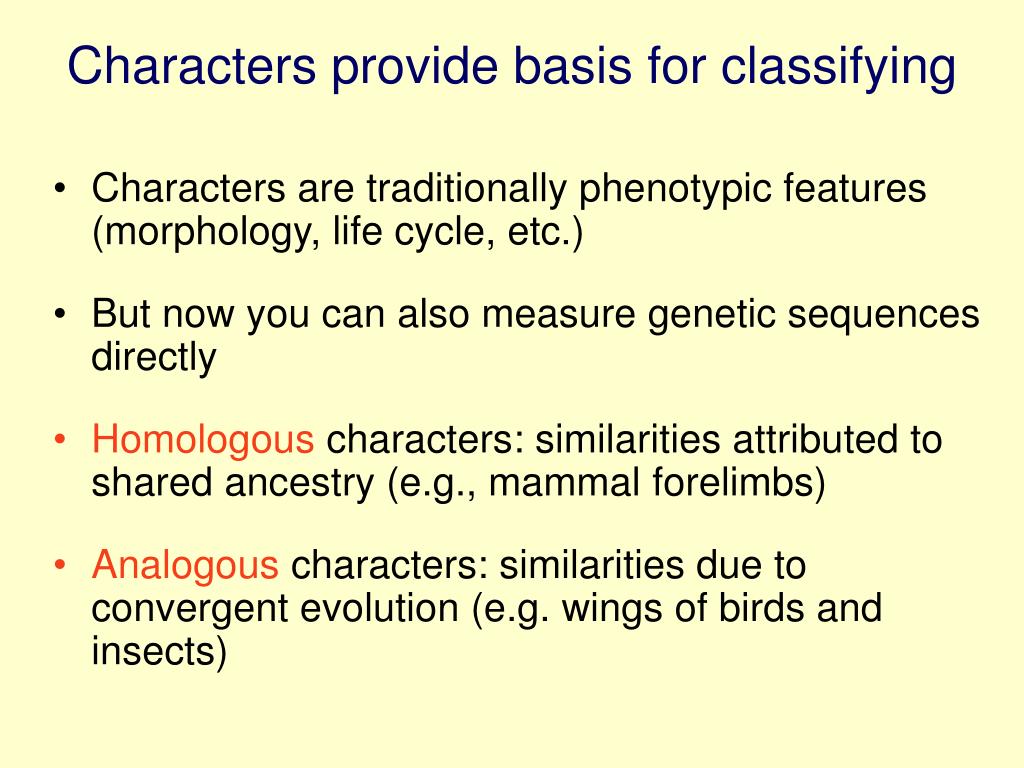
  1. Characters provide basis for classifying • Characters are traditionally phenotypic features (morphology, life cycle, etc.) • But now you can also measure genetic sequences directly • Homologous characters: similarities attributed to shared ancestry (e.g., mammal forelimbs) • Analogous characters: similarities due to convergent evolution (e.g. wings of birds and insects)

  2. Homology

  3. Analogy

  4. Analogy vs homology pitfall Is a 4-chambered heart an homologous or analogous character between mammals & birds? Analogous Homologous

  5. “Agency” of selection • At what level does natural selection occur? • Darwin “organismal” • But selection can act at other levels • Genes • Cells • (Organisms) • Groups (social insects) • Species?

  6. Group vs. Individual Selection Controversy Selection at any higher level than that of an individual is essentially "impotent“ and is "not an appreciable factor in evolution" (1966:8; cf., Williams 1992). “Many, perhaps most, evolutionary biologists believe that it [group selection] is only rarely an important force of evolution.” (Futuyma 1998, p. 352)

  7. It is sometimes said, “Group selection was vanquished in the 1960s by William Hamilton and his ‘gene’s eye view’ of selection, which is the basis of Richard Dawkins’ notion of the selfish gene.” “The fundamental unit of selection, and therefore of self-interest, is not the species, nor the group, nor even, strictly, the individual. It is the gene, the unit of heredity.” (Dawkins, 1976)

  8. “Efficacy” of selection • Does natural selection account for all of evolution? • “Constraints” may channel evolution • Developmental • Structural

  9. “Scope” of selection • Can gradual microevolution account for all of evolution? • What about mass extinctions? • Species selection?

  10. Your vessel (or host person) is a transient tool designed to • transmit genes • not necessarily live long & prosper & be happy…

  11. An itinerant selfish gene Said ‘Bodies aplenty I’ve seen. You think you’re so clever But I’ll live for ever. You’re just a survival machine. Richard Dawkins