Tailoring Chemisorption in Metallic Nanostructures via Quantum Confinement Effects
10 likes | 156 Vues
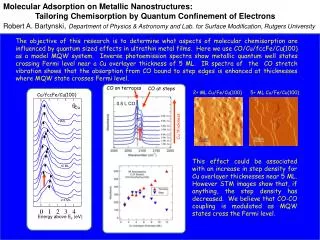
This research investigates the influence of quantum confinement on molecular chemisorption in ultrathin metal films, using a CO/Cu/fccFe/Cu(100) model quantum well system. Inverse photoemission spectra reveal metallic quantum well states intersecting the Fermi level at a Cu overlayer thickness of 5 ML, which correlates with enhanced CO adsorption at step edges. Although the step density appears decreased according to STM images, the enhancement may be linked to CO-CO coupling modulation as quantum well states interact with the Fermi level.


Tailoring Chemisorption in Metallic Nanostructures via Quantum Confinement Effects
E N D
Presentation Transcript
Molecular Adsorption on Metallic Nanostructures: Tailoring Chemisorption by Quantum Confinement of Electrons Robert A. Bartynski, Department of Physics & Astronomy and Lab. for Surface Modification, Rutgers University Cu/fccFe/Cu(100) q Cu 19ML 10 ML 2.5 ML 0 1 2 3 4 (eV) Energy above E F The objective of this research is to determine what aspects of molecular chemisorption are influenced by quantum sized effects in ultrathin metal films. Here we use CO/Cu/fccFe/Cu(100) as a model MQW system. Inverse photoemission spectra show metallic quantum well states crossing Fermi level near a Cu overlayer thickness of 5 ML. IR spectra of the CO stretch vibration shows that the absorption from CO bound to step edges is enhanced at thicknesses where MQW state crosses Fermi level. CO on terraces CO at steps 2+ ML Cu/Fe/Cu(100) 5+ ML Cu/Fe/Cu(100) 0.5 L CO Cu thickness This effect could be associated with an increase in step density for Cu overlayer thicknesses near 5 ML. However STM images show that, if anything, the step density has decreased. We believe that CO-CO coupling is modulated as MQW states cross the Fermi level.