Analysis of Subsurface Geology and Structural Zones in Seismically Active Environments
This document provides a comprehensive analysis of various subsurface geological formations and their characteristics in relation to seismic activity. It discusses the heated zones, dimensions of sedimentary layers, densities of muds, shales, and sands, and evaluates conditions for specific geological problems. A focus is placed on the implications of salt diapirism, tunnel stability, and slope behavior in massive igneous rock formations, providing insights into the geological interactions affecting earthquake events.

Analysis of Subsurface Geology and Structural Zones in Seismically Active Environments
E N D
Presentation Transcript
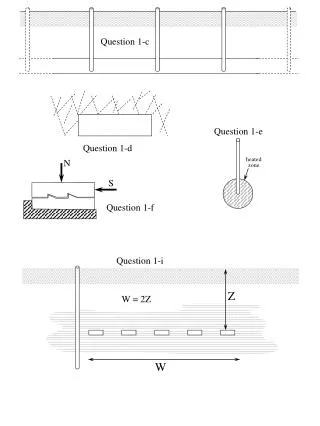
Z W = 2Z W Question 1-c Question 1-e Question 1-d N heated zone S Question 1-f Question 1-i
smax Point (r, ) sr smin B radius, r sq angle, q pi A R Conditions for the Problem: smax/smin = 1.5 pi = 0.8 smin h A H B Question 4
400 m sea water 500 m muds g = 1.8 g/cm3 2000 m shale g = 2.40 g/cm3 1000 m sands, shales g = 2.25 g/cm3 Earthquake event 4000 m A Salt diapir slough 200 m 2000 m Tunnel - 6 m f Parallel to the bedding of alternating limestones and shales interbedded at 0.3 to 2 m thickness Slope in massive igneous rock with mild schistosity parallel to slope face