Pulse Width Modulation
This comprehensive presentation led by Dr. Miguel Alonso Jr. explores Pulse Width Modulation (PWM) principles, types, and its applications in telecommunications and motor control systems. Learn about the technique of PWM generation, including intersective and digital methods, as well as the implications of transmission bandwidth. The presentation also discusses crucial schematics for PWM circuits, providing a foundation for group projects. Discover how the duty cycle varies with message signals, creating efficient data encoding and power control methods through practical examples.

Pulse Width Modulation
E N D
Presentation Transcript
Pulse Width Modulation Professor: Dr. Miguel Alonso Jr.
Outline • Principle • Types • Transmission Bandwidth • Technique for Generation • Other Applications • Schematics of the project PWM circuit (foundation for group projects)
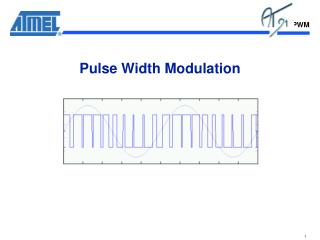
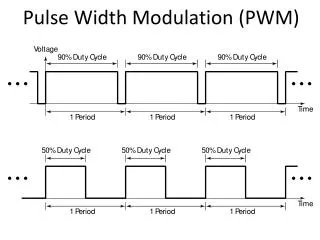
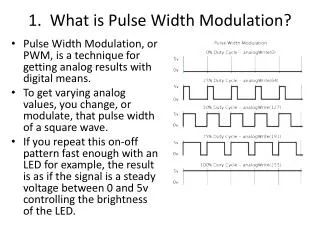
Principle • Pulse width modulation uses a square wave and varies the duty cycle to convey the information • The duty cycle is directly proportional to the amplitude of the message signal
Types • Three types of pulse-width modulation (PWM) are possible. • The pulse center may be fixed in the center of the time window and both edges of the pulse moved to compress or expand the width • The lead edge can be held at the lead edge of the window and the tail edge modulated. • The tail edge can be fixed and the lead edge modulated
Transmission Bandwidth • Much more complex than PAM tranmission bandwidth • Recall BT = K1/τ • This is a course approximation • A fine approximation is needed for PWM • BT = 0.5/trise
Example • A Baseband signal with a bandwidth of 10kHz is to be sampled and converted into a PWM signal. Rise time cannot exceed 1% of the sampling time interval. Determine the approximate transmission bandwidth. Assume the minimum Nyquist sampling rate.
Techniques for Generation • Intersective • Digital (using a microcontroller and a counter to count the pulse width) • In intersective generation of a PWM, the message signal is compared to a sawtooth waveform. • When the message signal is greater than the sawtooth, the out goes high, otherwise, it goes low
Other Applications • Telecommunications – the width of the pulse can correspond to specific data values encoded at the transmitter ( we will talk about encoding schemes later on) • Motor Control – the average power delivered to the motor is proportional to the pulse width