Enhancing Business Innovation through Knowledge Transfer Partnerships (KTP) Support
130 likes | 242 Vues
Discover how the DRI can facilitate Knowledge Transfer Partnerships (KTPs) to drive innovation in businesses. We provide comprehensive support including project matching, financial checks, and helping companies navigate the KTP application process. With clear guidance on project costs, budgets, and requirements, we ensure the success of your partnership. Benefits of KTPs include knowledge transfer, project management, and improved business outcomes. Learn from successful case studies and access essential resources to kickstart your KTP journey.


Enhancing Business Innovation through Knowledge Transfer Partnerships (KTP) Support
E N D
Presentation Transcript
Knowledge Transfer Partnerships Process February 3rd 2011
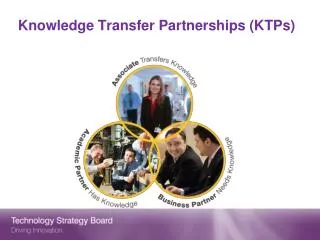
How can DRI help with KTPs? • Facilitate meetings with Companies, KTP advisors – ‘project match’ • Advise on type of KTP project and process • Company financial checks using ‘Fame’ • Prepare projects costs and budgets • Manage submission process and contracts • Promote KTPs externally at Business events / Internal seminars • Attend KTP initial meetings • Assess progress of KTPs, input claims
Classic KTP – Application process • 1st Stage – EOI (2 - 4 weeks) • 2nd Stage - Full application (2 - 4 weeks) • Programme Advisory Group (4 weeks) • Grant offer letter (4 weeks) 12 – 16 weeks
What makes a good application? • Writing the bid together • Clear finances, letters of support / business plan • Meeting sponsor priorities • A work-plan that shows • Transfer of knowledge • Embedding of knowledge • Clear Outputs and Outcomes – ideally linked! • Clear Milestones
What happens once funding is given? • Grant Offer Letter provided by TSB to company & University • KTP acceptance agreement signed with company • Project Code Issued • Job Description and terms of employment agreed between company and university • Recruitment starts (associate not on HERA) • KTP agreement signed • Pre start of project meeting (LMCO) • Project START! 6 months
What makes a good project? • Investment in time to solve company problems • Joint desire to ‘supervise’ associate • Managing expectations of partnership • Good project management • Open Innovation • Adhering to work-plan • Reading guidance notes & attending Supervisor workshops!
What is expected from academic supervisor? • Proposal writing, IEF • Risk Register • Financial budget management with quarterly claims • ½ day a week time, visit once every 2 weeks • Local Management Committee every quarter • Associate recruitment, induction, development, appraisal
Examples of KTP: Product Launch College of Engineering: Biometrics Developed new biometrics prototype for , launched and implemented across whole business saving £500k per annum for company
Examples of KTP: Proving a process! School of Business: Actuarial Modelling • Local start up company ‘Indico’ who predict automotive quality and service issues and warranty claims – think Toyota brakes!!!! • To embed statistical methods for assessing automotive part failure rates throughout the company’s business activities.
Examples of KTP: Proving a process! College of Medicine: Medical engineering • Local company ‘Ruskinn’ a leading supplier and manufacturer of anaerobic and modified atmosphere workstations. • To create a product development capability that allows the company to develop new product lines and increase market share of biomedical research workstations.
Want to find out more? Useful websites KTP: http://www.ktponline.org.uk/ TSB: http://www.innovateuk.org/deliveringinnovation/knowledgetransferpartnerships.ashx DRI: http://www.swansea.ac.uk/research_innovation/ResearchandProjectSupport/KnowledgeTransferPartnerships/KTPresources/ Useful Numbers Ali Parker – 01792 60 2630 a.c.parker@swansea.ac.uk David Notley – 07941207801 davidnotley@impactmc.co.uk