Long-Term Memory
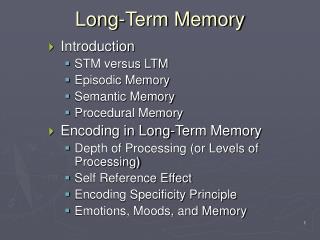
Long-term memory (LTM) is a critical component of our cognitive system, storing information not retained in short-term memory. It can be categorized into procedural memory, which involves skills and actions that become automatic with practice, and declarative memory, which consists of episodic and semantic memory. Episodic memory includes personal life events, while semantic memory stores general knowledge. Semantic Network Theory illustrates how we organize and retrieve memories through interconnected hierarchical networks. Explore your understanding by creating your own semantic network example.

Long-Term Memory
E N D
Presentation Transcript
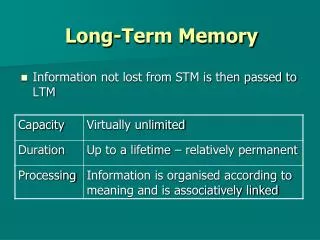
Long-Term Memory • Information not lost from STM is then passed to LTM
Procedural Memory (actions) • Stores knowledge of how to do things • Starts slowly, over time -> faster (automatic) • Resistant to forgetting • What examples can you think of????
Declarative Memory (information) • Contains information about the world • Episodic Memory (events) • Information about yourself, things that have happened involving you • Personalised knowledge • Autobiographical • Subject to forgetting – less useful • Semantic Memory (facts) • General information about the world • Includes facts, figures and other information • Encyclopaedic • Less subject to forgetting – more useful
Organisation of information in LTM – Semantic Network Theory
SEMANTIC NETWORK THEORY • LTM is organised systematically into hierarchical networks arranged as interrelated categories and sub-categories • Short link between 2 concepts indicates strong association • Information is organised in terms of meaning • Information is organised as concepts • A concept is a piece of information together with the characteristics (properties) of that information • The concepts are organised hierarchically • Broadest at the top
SEMANTIC NETWORK THEORY continued • Based on studies that required p’s to memorise lists of words which could be placed into any of 4 categories (not disclosed to p’s) • 60 words – presented in random order • p’s tended to recall the words in their categories (animals, vegetables, names and occupations) despite the originally random presentation
Have a go at creating your own example of Semantic Network Eg. Food