
SlideServe
Menu
Préférences
© SlideServe · v2026

Carbon, Water, and Energy Balance in Arctic Landscapes: Insights from Flagship Observatories

coyne avatar
15 diapositives · 312 Views · Sep 10, 2014

This project explores the carbon, water, and energy dynamics of Arctic landscapes through flagship observatories, notably Toolik and Cherskii. Implemented under the PanArctic Network, it examines ecosystem responses in terms of net CO2 exchange, methane emissions, water balance, and energy budgets. The study incorporates multivariable time-series analyses and integrates findings from workshops and international collaborations. Vital for understanding Arctic ecology and climate change impacts, this project also emphasizes educational outreach and data sharing across diverse ecological research frameworks.
Carbon, Water, and Energy Balance in Arctic Landscapes: Insights from Flagship Observatories - slide 1
01 / 15Carbon, Water, and Energy Balance in Arctic Landscapes: Insights from Flagship Observatories
1 / 17

Télécharger la présentation

Carbon, Water, and Energy Balance in Arctic Landscapes: Insights from Flagship Observatories
Une image / un lien ci-dessous est fourni (tel quel) pour télécharger la présentation

Politique de téléchargement : le contenu du site vous est fourni TEL QUEL pour votre information et votre usage personnel ; il ne peut être vendu, concédé sous licence ni partagé sur d’autres sites sans l’accord de son auteur.Le contenu vous est fourni TEL QUEL, pour votre information et votre usage personnel uniquement. Téléchargez la présentation en cliquant sur ce lien. Lors du téléchargement, si vous ne parvenez pas à télécharger une présentation, l’éditeur a peut-être supprimé le fichier de son serveur.Pendant le téléchargement, si vous ne parvenez pas à obtenir une présentation, le fichier a peut-être été supprimé par l’éditeur.

F I N

Plus de contenu associé

Transcription de la présentation
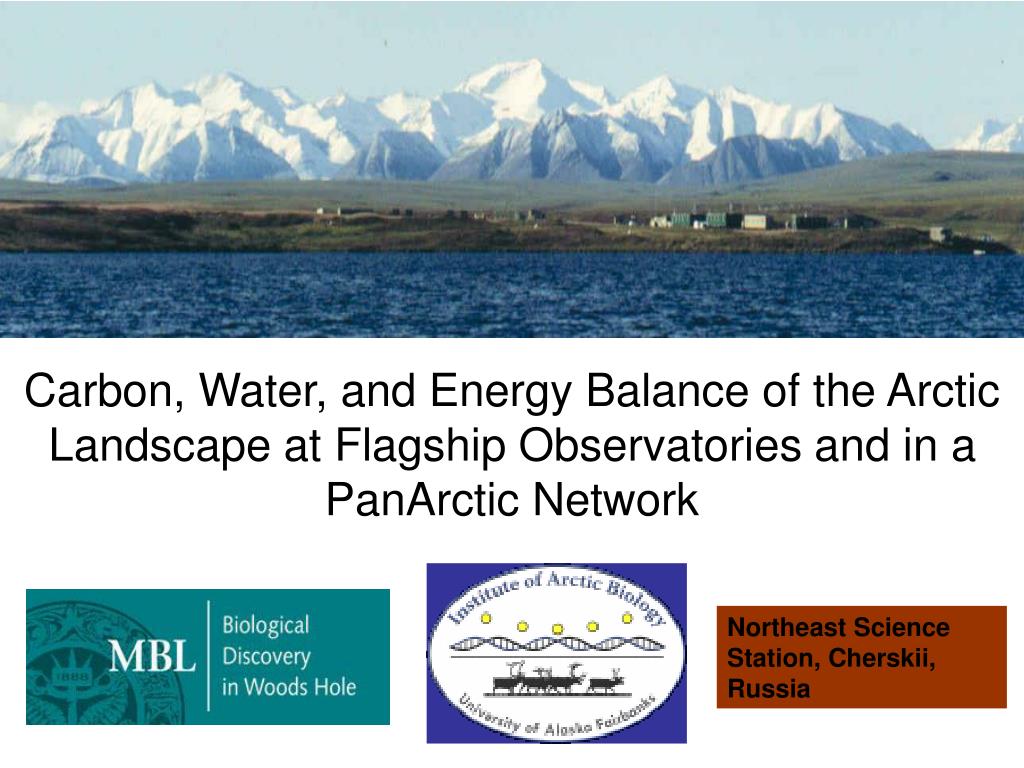
  1. Carbon, Water, and Energy Balance of the Arctic Landscape at Flagship Observatories and in a PanArctic Network Northeast Science Station, Cherskii, Russia

  2. Carbon/Water/Energy Project • Toolik Observatory • Cherskii Observatory • PanArctic Network • Arctic Ecology Course

  3. Net Ecosystem CO2 exchange (NEE) Methane Dissolved C/element losses Water balance Surface energy balance Weather and microclimate Vegetation pattern and reflectance Multivariable time series Patch/footprint analyses Landscape element/energy budgets PanArctic comparisons, modeling Toolik, Cherskii, PanArctic data bases Arctic LTER NSIDC PanArctic Data and analyses

  4. Schedule and timing • Summer 2007: Set up Cherskii & Toolik Observatories • Year-round operation of tower flux and weather observations; summer only patch-scale studies, hydrology and stream chemistry; operate through 2007-2010 • Three PanArctic data meetings with international collaborators; first in Woods Hole winter 2007-2008, others @ Toolik 2008 and 2009 • Summer course @ Toolik 2007-2010

  5. Steering Committee (Bret-Harte, Barnes, Hobbie, Rastetter, Shaver, Zimov) Collaborating sites and projects Advisory Committee Toolik Observatory (Shaver, Bret-Harte, Euskirchen) Network/Data Base (Rastetter, Postdoc, Collaborators) Education (Barnes, Hobbie, Kade) Cherskii Observatory (Zimov, Walter, Bret-Harte) Data Workshops (Rastetter, Postdoc, Collaborators) Eddy Flux/micromet (Euskirchen, Shaver, Bret-Harte) Eddy Flux/micromet (Zimov, Walter, Euskirchen) Field Course (Kade, All) Modeling workshops (Rastetter, Collaborators) Hydrology/Chemistry (Hobbie, LTER) Hydrology/Chemistry (Zimov, Cherskii staff) Seminar (Kade, All) PanArctic Data Base (LTER, NSIDC, Collabs) Fine Scale Fluxes (Bret-Harte, Shaver) Fine Scale Fluxes (Zimov, Walter) Outreach (Kade, All) PanArctic syntheses (IPY, SEARCH) Methane (Walter) Methane (Walter) Vegetation & NDVI (Bret-Harte, Shaver) Vegetation & NDVI (Zimov, Walter) Global syntheses (Global modeling orgs) Local Data Base (TFS, LTER) Local Data Base (Cherskii Staff, LTER)

  6. Toolik Lake at the intersection of three major environmental programs NRC “Grand Challenges in Environmental Science” • Biodiversity • Biogeochemistry • Climate Change • Hydroecology • Infectious disease • Invasive species • Land use AON LTER NEON

  7. Figure 2-3. The conceptual framework of the Arctic LTER project with a background of the foothills and mountains at Toolik Lake, Alaska (modified from the U.S. Postal Series Number 5, Nature of America). The large boxes are the three components of the landscape. The bullets inside the boxes are the factors and linkages within ecosystems that affect the formation, transformation, and movement of water, nutrients, and organic matter (OM). The two smaller boxes are the linkages between components. The bullets inside the boxes are the factors that control the transport and transformation of between components. BGC is biogeochemical; OM is organic matter; N is nitrogen; DIN is dissolved inorganic nitrogen.

  8. Long-Term Ecological Research (LTER) Network The 26 U.S. sites lie in a variety of biotic and climate zones. They include arctic tundra, taiga, temperate forest, coniferous forest, grassland, desert, lakes, coastal, estuarine, and urban sites.