
SlideServe
Menu
Préférences
© SlideServe · v2026

Crafting Effective Advertisements: Skills for Young Writers

csilla avatar
18 diapositives · 356 Views · Aug 01, 2014

In this week’s lesson, students will explore the essential elements of advertisements while understanding the significance of their target audience. They will learn how to draft, revise, and publish advertisements for both children and parents. Through engaging activities such as reading poems and discussing dreams, students will enhance their writing and critical thinking skills. They will also study word structures, suffixes, and prefixes, which will help them create compelling ads that resonate with their desired audience.
Crafting Effective Advertisements: Skills for Young Writers - slide 1
01 / 18Crafting Effective Advertisements: Skills for Young Writers
1 / 17

Télécharger la présentation

Crafting Effective Advertisements: Skills for Young Writers
Une image / un lien ci-dessous est fourni (tel quel) pour télécharger la présentation

Politique de téléchargement : le contenu du site vous est fourni TEL QUEL pour votre information et votre usage personnel ; il ne peut être vendu, concédé sous licence ni partagé sur d’autres sites sans l’accord de son auteur.Le contenu vous est fourni TEL QUEL, pour votre information et votre usage personnel uniquement. Téléchargez la présentation en cliquant sur ce lien. Lors du téléchargement, si vous ne parvenez pas à télécharger une présentation, l’éditeur a peut-être supprimé le fichier de son serveur.Pendant le téléchargement, si vous ne parvenez pas à obtenir une présentation, le fichier a peut-être été supprimé par l’éditeur.

F I N

Plus de contenu associé

Transcription de la présentation
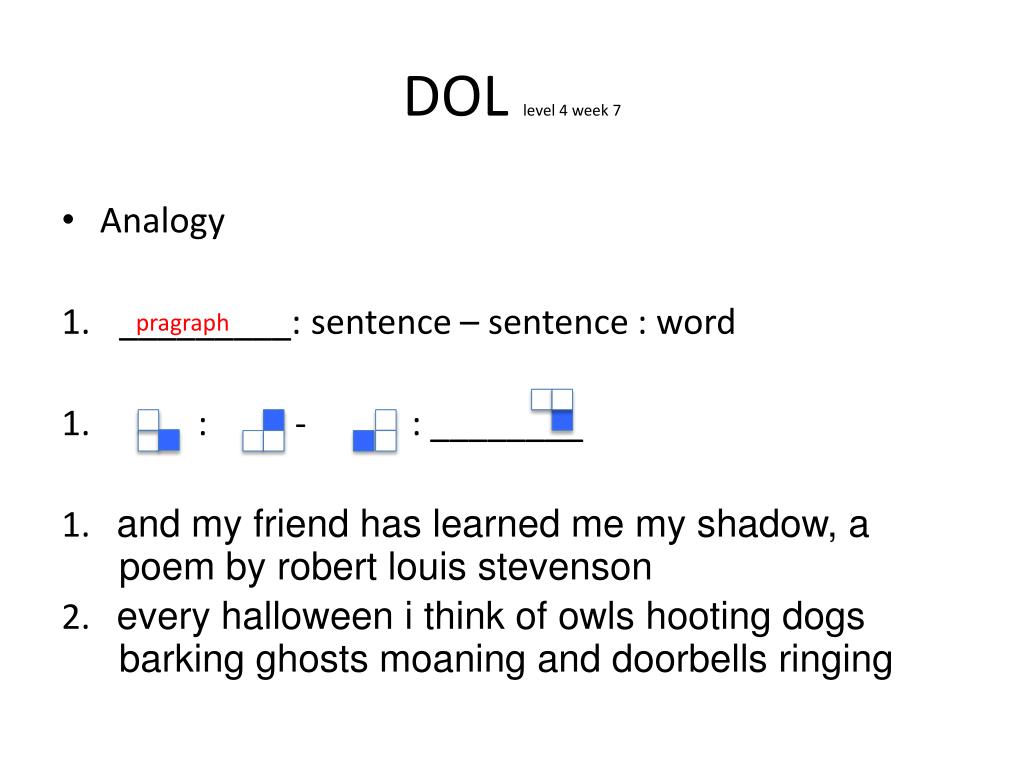
  1. DOL level 4 week 7 • Analogy • _________: sentence – sentence : word • : - : ________ 1. and my friend has learned me my shadow, a poem by robert louis stevenson 2. every halloween i think of owls hooting dogs barking ghosts moaning and doorbells ringing pragraph

  2. Pledge

  3. Fluency 6 min. reading solution

  4. Objectives Students will • Learn the basic elements of advertisements. • Learn the importance of knowing their audience. • Draft, revise, and edit their pieces. • Publish their ads.

  5. Word Structure Line 1 Line 2 Line 3 Line 4 Line 5 Root word, suffixed –ly and-ness Prefixed re-, un-, and en- Selling changes with suffixes; Suffixed –y, -ful, and -less Verb endings –ed and –ing; noun-pluralizing ending –s/-es . Compound word

  6. Insert Vocabulary • 1. pursued, cover, idly • 2 shuddered, delivered, concealed • 3. obviously, gnawing, circumstances • 4 tensely, concerned, strive • 5. brilliant, nudged, plunged

  7. Poety • Do you have a dream about accomplishing something? • Share your dream. • Read the poems on page 122 aloud in a voice filled with earnestness and a touch of sadness.

  8. Reading with a Writer’s Eye

  9. Writing an Advertisement • “My older sister taught me how to play the guitar. My friends at school are always asking me to teach them, so I think I will start giving lessons. First, I need to write an advertisement.”

  10. DraftingCreate two ads: one for children and one for parents • Possible Ad for Children Have you ever wanted to join a band to impress your friends and play the latest songs? Learn how to play the guitar from someone your age who has years of experience! • Possible Ad for Adults Do you want your children to learn how to play a musical instrument they won’t get bored with– one they will want to play for many years? Let your children learn how to play the guitar from someone who has years of experience—someone they can relate to!

  11. Guided Practice Creating an ad serves a real purpose. Brainstorm ideas for a product or service to sell. 1. 2 3 4 5 6 7 8 9 10

  12. cause effect If If If customer x buys this product. Then he or she will have whiter teeth If If If If

  13. DraftingCreate two ads:One for children and one for parents. Possible ad for children

  14. Set Purposes • Why do people take risks?

  15. Grammar, Usage, and Mechanics Write a brief paragraph on the topic of Risks and Consequences. Use may of the writing skills and strategies you learned in this unit. Your paragraphs should include at least one example of each element learned in this unit’s Grammar, Usage, and Mechanics. Exchange your paragraphs with a peer and edit them for proper usage.

  16. Spelling

  17. Grammar, Usage and MechanicsNouns as Direct Objects and Objects of Prepositions Mr. Hughes loved his son. Langston’s book lay on the desk. A noun can be the subject or an object in a sentence. A noun that receives the action of the verb is the direct object; for example, son in the first sentence. A noun that is at the end of a prepositional phrase is the object of the preposition; for example, desk in the second sentence. Noun names a person, place, thing or idea and a proper noun names a particular person, place, thing, or idea. Proper nouns should be capitalized. Write sentences on the board that contain direct objects and objects of prepositions.

  18. Rotations