The Rise and Impact of WWII: A Comprehensive Overview of Global Conflict (1939-1945)
This document explores the origins, key events, and aftermath of World War II, the largest conflict in history, spanning from 1939 to 1945. It examines the rise of totalitarian regimes in Germany, Italy, and Japan, the aggressive expansionist policies that led to global war, and the significant battles fought across multiple theaters. Key figures, including Hitler and Roosevelt, are highlighted alongside pivotal moments like D-Day and the Holocaust. The war's conclusion shifted global power dynamics, ultimately leading to the Cold War era, marked by tensions between the US and the Soviet Union.

The Rise and Impact of WWII: A Comprehensive Overview of Global Conflict (1939-1945)
E N D
Presentation Transcript
WWII 1939-1945
The start • ____ years after WWI • Causes • ______________________wanted to expand their countries into empires. • Conquering other countries • Read Ch 12 section 2, start at WWII
Powers • _________ • Britain • France • Soviet Union • U.S. • China • ___________ • Germany • Italy • Japan
The Rise of Totalitarian Rulers • The government has ______ control over the country and its citizens • Use ________ to enforce laws and punish opposition • Regimes seized power in __________, _________, and _____________.
Italy • ___________ rose to power • _________: government should include their own political party and no others. • Total government control of political, economic, religious, and cultural activities • Ll Duce- “_____________” • Used his private military squads- ______________
Germany • ____________rose to power • _______ party • Private military squads- “_____________” • Nazis launched vicious verbal and physical attacks against _____ and opposition • When Germany’s President Paul von Hindenburg died in 1934, Hitler appointed himself Fuhrer and Reichskanzler (leader and Reich Chancellor) • Nazis abolished freedom of _________, _________, _______, _______, _______ • Many Jews were sent to _________________harsh, brutal prisons
The Holocaust • Hitler used Jews as a _________- unfairly blaming them for existing problems • Nazis took right away from _______ • Not German citizens • Fired them from their jobs • Took businesses and schools • _____________ • Systematic murder of about ________Jews and millions of other Europeans believed to be inferior and unfit to be German Citizens • Gypsies, Slavs, political enemies, handicapped, homosexuals.
The European War • ____________German Empire that Hitler was creating as he took over countries (Austria, Czechoslovakia, and Poland) • ________________, Hitler invaded Poland. • _______________________declared war on Germany 2 days later • Start of WWII, largest and deadliest war ever fought, ____________people
Battles • ___________________war for control of Europe and the Soviet Union • ___________________where the US led the battle against Japan
European Theater • Soviet Union was under ________________ • Ruthless in domination over soviets • Wanted large empire • Made pact with Hitler not to attack each other, divide __________ • ____________Hitler broke the pact and invaded the SU • Stalin joined _______
Battle of __________ 1942 • Major turning point in eastern front of European Theater • _________battle in human history, 1-2 million • Centered around German’s attempt to defeat SU • Axis powers lost ________ of military force on eastern front • Soon after, Germans begin retreating
Western Front • Allied attempt to liberate western Europe from Hitler’s control • Led by GB and US • _________- GB leader during the war • Tremendous speaking voice and words rallied citizens • British withstood German bombing campaigns • _______________________________________US president during the war • Also had captivating speaking style • Did not commit troops and resourced until US was well prepared
D-Day • __________________ • Allied forces began their invasion of German-held Western Europe • Greatest _________ invasion in history • Crossed the __________________to land on the beaches of _______________, France. • Lead by (lead by later US President__________________________________ • SUCCESSFUL • Germany forced to Surrender on ________________
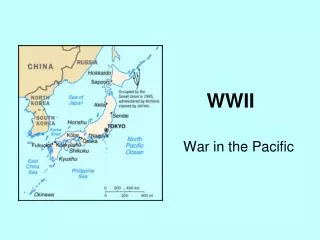
Pacific Theater • US led the battle against ________________ • Battle of ____________ • June 1942 • Air battle • US victorious • US now had more sea power than Japan • US forces began fighting their way toward Japan
Australia and Pacific Islands were also part of the war. • ______________Australians lost their lives in the war • President Roosevelt died _____________ • Vice Pres. _____________________ • He helped to end the war • Germany’s unconditional surrender ___________ • _______________ Conference July 12- August 2, 1945, • August 1945 ordered _________________________be dropped on ____________ and ____________ in Japan • Brought about end to war. Officially on _________________________
Start of the Cold War • The US and ______________worked together to defeat Axis powers • They were left as ________________ far more powerful than any other countries on Earth • Tensions grew • US was democratic Soviet Union was __________ • Stalin wanted to spread _______________. • US opposed expansion of Soviet power and communism • Became known as the ______________ • No actual fighting took place