Une image / un lien ci-dessous est fourni (tel quel) pour télécharger la présentation
Politique de téléchargement : le contenu du site vous est fourni TEL QUEL pour votre information et votre usage personnel ; il ne peut être vendu, concédé sous licence ni partagé sur d’autres sites sans l’accord de son auteur.Le contenu vous est fourni TEL QUEL, pour votre information et votre usage personnel uniquement.Téléchargez la présentation en cliquant sur ce lien.Lors du téléchargement, si vous ne parvenez pas à télécharger une présentation, l’éditeur a peut-être supprimé le fichier de son serveur.Pendant le téléchargement, si vous ne parvenez pas à obtenir une présentation, le fichier a peut-être été supprimé par l’éditeur.
Surface area to volume lab demo • http://www.youtube.com/watch?v=xuG4ZZ1GbzI&feature=youtube_gdata_player • Why are cells so small??? • http://www.youtube.com/watch?v=wuXSEOKNxN8&feature=youtube_gdata_player
Lab groups of 6 • 2 will measure/time the 1cm cube • 2 will measure/time the 2 cm cube • 2 will measure/time the 3 cm cube • On your own notebook paper • Write: • Title, data chart, calculations for your cube, observations as it happens. Add the group data to your data chart. Put your paper in your notebook. • The group will compile one report from this to turn in together for a grade! Answer all questions
Cell communication • Cell communication can not take place if the cell is too large because it involves signaling proteins that would be too far away from the molecules.
-cell division solves a cell's size problem • a cell needs a large surface area relative to its volume • (a high surface-to-volume ratio) to survive When the cell reaches its size limit it will stop growing or it will divide!
Stages of Interphase Normal cell day to day life of a cell!! -interphase = when the cell grows, carries out cellular functions and replicates its DNA to prepare for the division phase! Or the period between cell divisions. It is the longest of the phases! • -Gap 1 (G1) -cell growth & development • -DNA Synthesis (S) -replication of DNA • -Gap 2 (G2) -creation of materials needed for division • Doubling the nuclear material in the S-phase provides enough DNA to generate 2 complete nuclei at the end of mitosis. This ensures that each daughter cell has the same number of chromosomes as the original parent cell.
Mitosis and Cell Division • All cells go through a cell cycle composed of cell division portion (mitosis) and "resting period" (interphase).
Nucleus • Usually large enough to be seen with light microscope. Double membrane (nuclear envelope) bound organelle with pores. The nucleus is the "control center" for the cell since it contains the hereditary material
DNA • within chromatin. • Condensed chromatin (during cell division) is visible with the microscope as chromosomes. • Inside the nucleus is a dark staining region called the nucleolus which is involved in making ribosomal RNA (rRNA). • Think of this as city hall • (archives genealogical data)!
Making a chromosome • 1. DNA is 1st copied 2 identical strands make up chromatids • 2nd the DNA wraps around proteins called histones the chromatids connect at the center called the centromere.
How chromosome # and structure affect development • Each body cell (somatic cell ) has 23 different chromosome pairs for a total of 46 • Each chromosome has thousands of genes on them that are essential to life!
What are sets of chromosomes called? • Homologous pairs • Homologous chromosomes are ones that are similar in size, shape and information that they contain. • One comes from each parent
Chromosomes • Are present in the nucleus. Occur as chromatin (uncondensed) and chromosomes (condensed during cell division). Composed of a strand of DNA and associated proteins. The DNA stores and transmits genetic information, while the proteins are important for packaging these long strands of DNA.
Details of DNA structure • DNA is a double helix composed of a backbone of phosphate and sugar groups. • From the sugars, nucleotide bases protrude. Four nucleotides exist in DNA: A, C, G, and T. • A pairs with T, • G with C. • The two strands run antiparallel (opposite directions) and the bases hydrogen bond together. Genes are composed of sections of DNA that encompass hundreds to thousands of base pairs.
Prokaryotic Cells • Since Prokaryotic cells do not have a nucleus they reproduce my a much simpler method with out the cell cycle that eukaryotes have. It is called binary fission.
Binary Fission • The chromosome replicates and the cell divides making 2 exact copies of the cell.
1. What factor limits the size of a cell the most? Surface area to volume ratio_ • 2. How do most substances move from one area of the cell to another? Difusion • 3. Is this movement easier when the cell is small or large? Small • 4. How does cell size affect cell communication? If it gets too large it will no be able to communicate.
6. Which phase seems to be the longest? interphase 7. What happens in Mitosis? The genetic material divides • 8. What happens in cytokinesis? The cytoplasm and organelles divide 9. What happens in the G1 phase of interphase? -cell growth & development • 10. What happens in the S phase? -replication of DNA • 11. What happens in the G2 Phase? creation of materials needed for division • 12. What is the difference between chromosomes and chromatin? Chromosomes are packaged and only show up when the cell is ready to divide, chromatin is the unwound form of DNA when it is in use by the cell. • 13. Do prokaryotic cells divide with this cell cycle? No What is the method they use called? Binary fission
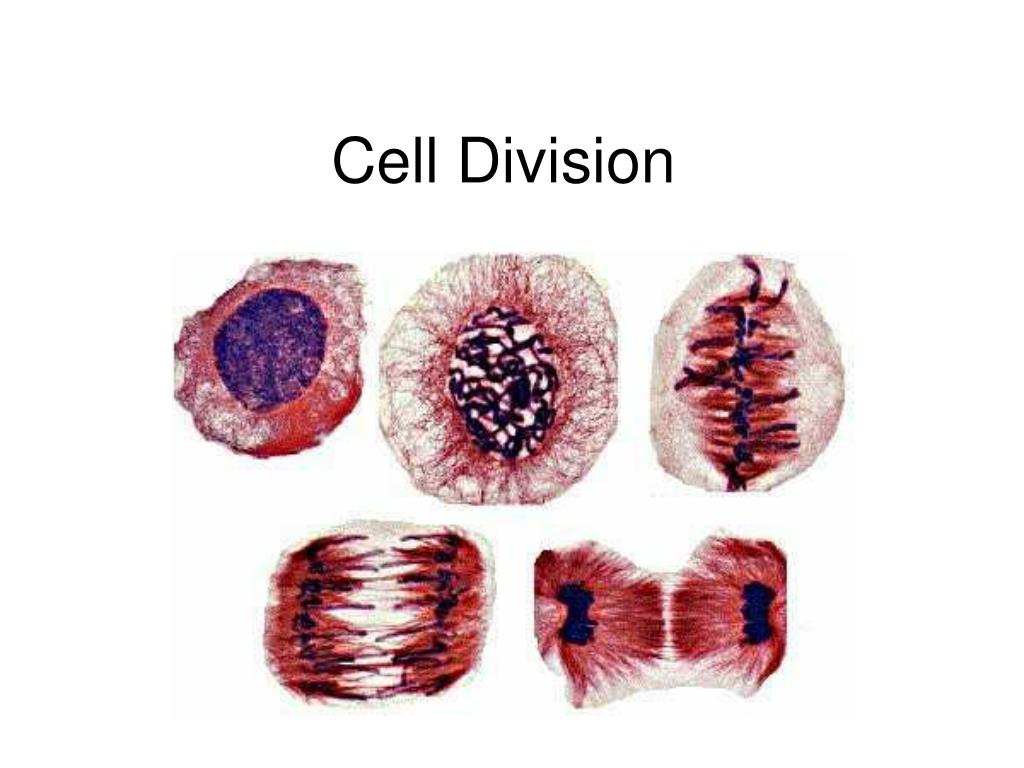
Stages of mitosis • The division of the nucleus is considered a separate process from the division of the cytoplasm. • Mitosis: nucleus division • Cytokinesis: cytoplasm division
Prophase • the chromatids continue to condense; the nuclear envelope and nucleolus disintegrate; • the spindle apparatus forms (fibers composed of microtubules responsible for the movement of the chromosomes); • kinetochores form (protein containing structures that serve to attach the chromatids to the spindle fibers)
Metaphase • spindle fibers attach to chromosomes at the kinetochores; • kinetochore fibers orient the chromosomes so that only one chromatid will move to each pole {8-13R} • the central region where the chromosomes align is called the equator or metaphase plate
Connexion au compte
Connectez-vous pour publier votre contenu sur SlideServe.