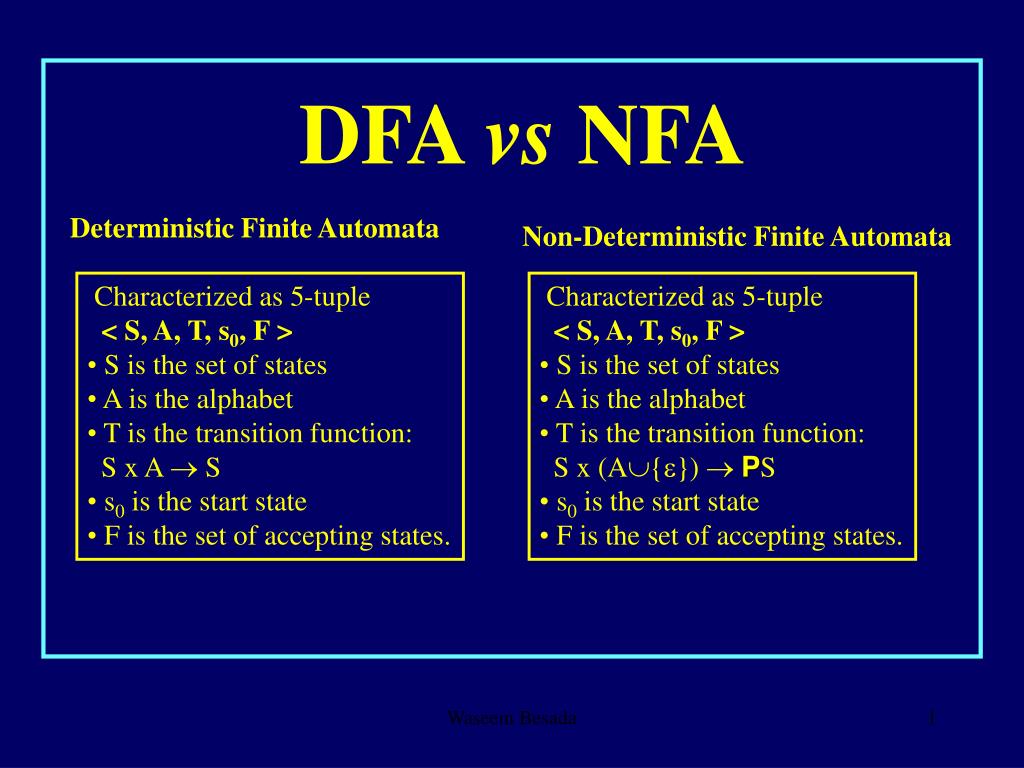
DFA vs NFA Deterministic Finite Automata Non-Deterministic Finite Automata • Characterized as 5-tuple < S, A, T, s0, F > • S is the set of states • A is the alphabet • T is the transition function: S x A S • s0 is the start state • F is the set of accepting states. • Characterized as 5-tuple < S, A, T, s0, F > • S is the set of states • A is the alphabet • T is the transition function: S x (A{}) PS • s0 is the start state • F is the set of accepting states. Waseem Besada
From NFA To DFA 1 Transition function for NFA b a 2 T a b 0 0 {1} ø {3} a 1 ø {2} ø 2 ø ø ø 3 {3} ø {4} 4 3 a 4 {2} ø ø Waseem Besada
Calculating The Transition function for DFA Transition function for NFA Transition function for DFA T a b T a b 0 {1} ø {3} {0,3,4} ? ? 1 ø {2} ø TD({0,3,4},a) = ({0},a) ({3},a) ({4},a) = {1,3} {3,4} {2} = {1,2,3,4} 2 ø ø ø 3 {3} ø {4} TD({0,3,4},b) = ({0},b) ({3},b) ({4},b) = ø ø ø = ø 4 {2} ø ø Waseem Besada
Calculating The Transition function for DFA (forts) Transition function for DFA Transition function for NFA T a b T a b {0,3,4} {1,2,3,4} ø 0 {1} ø {3} ø ? ? 1 ø {2} ø ø ø {1,2,3,4} ? ? 2 ø ø ø {2,3,4} {2} 3 {3} ø {4} TD({1,2,3,4},a) = ({1},a) ({2},a) ({3},a) ({2},a) = ø ø {3,4} {2} = {2,3,4} Similarly, TD({1,2,3,4},b) = {2} 4 {2} ø ø Waseem Besada
Calculating The Transition function for DFA (forts) Transition function for DFA Transition function for NFA T a b T a b {0,3,4}{1,2,3,4} ø 0 {1} ø {3} ø ø ø 1 ø {2} ø {1,2,3,4} {2,3,4}{2} 2 ø ø ø {2,3,4} {2,3,4}{2} 3 {3} ø {4} {2} ø ø 4 {2} ø ø Waseem Besada
Finally b Transition function for DFA 4 b T a b a,b a 0 1 2 3 4 {0,3,4}{1,2,3,4} ø 0 2 1 ø ? ? ø ø a b {1,2,3,4} {2,3,4}{2} 3 {2,3,4} {2,3,4}{2} a {2} ø ø Waseem Besada
Exercise 2, solution 2. Construct directly (that is don’t use the transformation procedure given in the lecture) a DFA for each of the following REs. a) a | b b) a | b* c) ab* | bc* b a a,b a,b a a,c a,b,c b a,b a a,b b a,b a,b c a) b c c) a b) b Waseem Besada
Exercise 4, solution 4. Construct directly (that is don’t use the transformation procedure given in the lecture) a NFA for each of the following REs. a) a*bc*| bc b) a* | ab a c a b a c a b b) a) Waseem Besada
Exercise 5 5. Construct a DFA table for the following NFA transition table. The start state is 0 and there is one accepting state, 2. a b 0 Ø {1,2} {1}1 {2} Ø Ø 2 Ø {2} {1} b 1 0 a b 2 b Waseem Besada
Solution to exercise 5 NFA transition table DFA transition table T a b a b 0 Ø {1,2} {1}1 {2} Ø Ø 2 Ø {2} {1} {0,1} ? ? {1,2} {1,2} 0 {1,2} {1,2} {1,2} 1 a,b a,b 0 1 Waseem Besada
Exercise 6 6. Consider the following NFA over the alphabet {a,b}: a) Find a regular expression for the language accepted by the NFA. b) Write down the transition table for the NFA. c) Transform the NFA into a DFA d) Draw a picture of the resulting DFA. a b 0 0 0 a Waseem Besada
Solution to exercise 6 (cont’d) Transition table for NFA T a b 0 {1}Ø {1,2} 1 Ø {2} Ø 2 {2} Ø Ø a b 0 1 2 a Waseem Besada
Solution to exercise 6 (cont’d) Transition table for NFA Transition table for DFA T a b {0,1,2} {1,2}{2} {1,2} {2} {2} {2} {2} Ø Ø Ø Ø T a b 0 {1}Ø {1,2} 1 Ø {2} Ø 2 {2} Ø Ø Waseem Besada
Solution to exercise 6(cont’d) {0,1,2} Transition table for DFA a {1,2} T a b {0,1,2} {1,2}{2} {1,2} {2} {2} {2} {2} Ø Ø Ø Ø b a,b {2} a Waseem Besada
Exercise 7 7. Transform each of the following REs into a NFA, then into a DFA a) a*b* b) a* | b* c) (a|b)* Solution to a) a b a 2 3 0 1 6 6 0 1 b 4 5 Waseem Besada
Solution, exercise 6-a T a b {0,1,2,3} {1,2,3} {2,3} {1,2,3} {1,2,3} {2,3} {2,3} Ø {2,3} Ø Ø Ø a b 0 1 2 3 a a Can be reduced to: 0 a a,b 1 b a 0 b a,b 2 3 b a 2 3 b b Waseem Besada
What to do next? It is your turn to solve the rest of the exercises Waseem Besada