Download
1 / 19
190 likes | 308 Vues
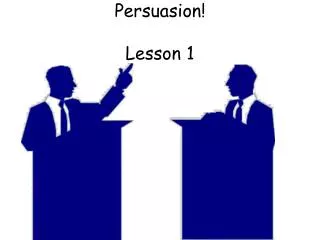
This lesson introduces the three pillars of persuasion: Ethos, Pathos, and Logos. Ethos focuses on moral character and credibility, raising questions about who possesses better ethos; for instance, a New York Times journalist versus a National Enquirer writer. Pathos evokes emotional responses, illustrated by contrasting an animal rights ad with an expert's ethical claim. Logos emphasizes logical reasoning, highlighting the difference between superficial and substantive arguments. We also discuss fallacies, expressions of grief (lament), and characteristics of language.

E N D
Ethos • Moral character, nature, disposition • Synonyms: character, reputation
Who has better ethos? • A man who works for the New York Times • A man who works for the National Enquirer
Pathos • A quality that arouses emotions • Synonyms: emotional appeal, human interest
Which is a better example of ethos? • An ad for animal rights depicting a cow in terrible living conditions • An expert in philosophy claiming that abusing cows is unethical
Logos • An appeal to logic
Which is a better example of logos? • You should be a new hybrid car because they look cool. • You should by a new hybrid car because it will save you money on gas.
Fallacious • Based on incorrect or misleading information • Synonyms: misleading, unfounded, illogical
rhetoric • the study of the effective use of language
Lament (v.) • to express grief verbally • Synonyms: mourn, bewail, grieve for
Which is a better example of lament? • A man feels sad about his mother’s passing. • A man expresses his grief to his friends through a poem
Nondescript (adj.) • Lacking characteristics • Synonyms: plain, undistinguished, ordinary
Fret (v.) • To worry • Synonyms: worry, stew
Relish (v.) • To enjoy • Synonyms: savor, enjoy, appreciate
Waif (n.) • A very thin, fragile looking person
Would an image of a waif appeal more to ethos, pathos, or logos?