Download
1 / 6
60 likes | 183 Vues
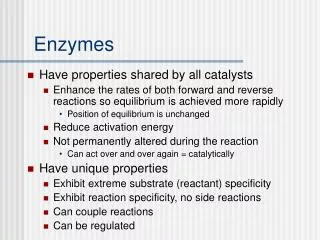
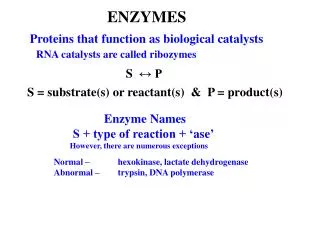
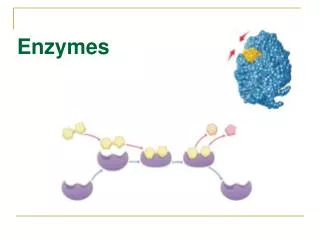
Enzymes are proteins also known as polypeptides, composed of amino acids linked by peptide bonds. They act as biochemical catalysts, accelerating chemical reactions without being altered themselves. Enzymes are highly specific and lower activation energy for reactions. Each enzyme reaction involves an enzyme, a substrate (the molecule acted upon), and products (the result of the reaction). Coenzymes, often vitamins, and cofactors like zinc and iron assist in these reactions, making them crucial for biological processes.

E N D
- All enzymes are proteins...proteins are also called “polypeptides”. • - Enzymes are made up of amino acids (amino group + carboxyl group (an organic acid) + “R” group”) • - held together by “peptide bonds” (bond between C and N) • - most enzymes end with “ase” • - Enzymes are “Biochemical catalysts”..... they trigger or accelerate a chemical reaction without being chemically altered themselves.
Enzymes are very “specific”. • Enzymes lower the amount of activation energy required to start a reaction.
An Enzyme Reaction includes an enzyme, a substrate, and products. • A Substrate is the molecule(s) acted upon in an enzyme reaction. • The Product(s) of a reaction are “What you make” as a result of a chemical reaction.
Coenzymes • Organic molecules that aid in enzyme reactions. • Many Vitamins are Coenzymes. The distinguishing feature of the vitamins is that they generally cannot be made by mammalian cells and, therefore, must be supplied in the diet.
Cofactors • Non-protein molecules, or ions, which aid in enzyme reactions. • Examples: Zinc, Iron and Copper.