Mastering Passive Voice for Effective Communication
150 likes | 176 Vues
Learn how to form and use passive voice in English, focusing on the action rather than the performer. Examples and practice exercises included.


Mastering Passive Voice for Effective Communication
E N D
Presentation Transcript
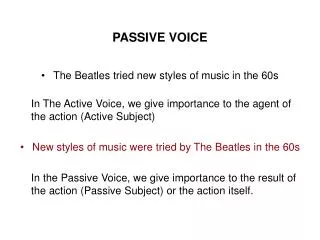
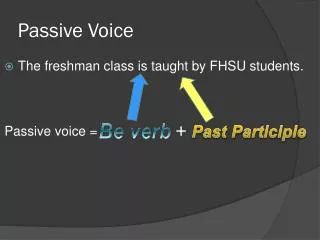
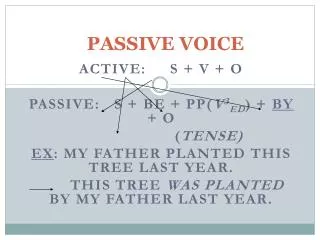
Passive Voice • form: to be+ pastparticiple(-ed) • it‘susedwhenthefocusis on theaction • it‘snotimportantwho or whatisperformingtheaction, buttheactionitselfisimportant • Thestreetsarecleaned. • Booksarewritten. • Houseisbuilt.
Passive Voice • statement • Everyone isinvited. • negative • Some people are not (aren’t) invited. • question • Is everyone invited?
Passive Voice • when rewriting active sentences in passive, the object of the active sentence becomes the subject of the passive • A: Somebody cleans this room every day. OBJECT • P: This room iscleaned every day. SUBJECT
Passive Voice • the verb BE has to be in the same tense as in active sentence • A: Someone stole my sister’s bike yesterday. • P: My sister’s bike wasstolen yesterday. • stole – past simple => BE = was/were • to show who did the action, we use BY • This house was built by my grandfather.
Passive Voice • to show whodidtheaction, weuseBY • Thishousewasbuiltby my grandfather. I => meshe => her you => youhe => him we => usthey => them • I openedthe door. => The door wasopenedby me. • Shecleanstheroom.=> Theroomiscleanedby her.
Passive Voice • if you are not sure how to form a passive sentence, think of the active sentence first • A: Someone stole my sister’s bike yesterday. • P: My sister’s bike wasstolen yesterday.
Passive Voice – present simple • form: am/is/are(not)+ past participle • The grandma is always invited. • Many accidents arecaused by dangerous driving. • I’m not invited to parties. • How many people areinjured in car accidents every year?
Passive Voice – past simple • form: was/were (not) + past participle • This room wascleaned. • During the night we werewoken up by a loud explosion. • When was the castle built? • This house wasn’tdamaged in the storm.
Rewrite the sentences into passive • 1. He opens the door. • 2. We set the table. • 3. Somebody lost the letter. • 4. The bill includes service. • 5. They invited uncle Adrian.
Rewrite the sentences into passive • 1. The door is opened by him. • 2. The table was set by us. • 3. The letter was lost by somebody. • 4. Service is included in the bill. • 5. Uncle Adrian was invited.
Write sentences from the words in brackets using passive voice – present • 1. (the office/clean/every day) • 2. (these rooms/clean/every day?) • 3. (glass/make/from sand) • 4. (stamps/sell/in a post office) • 5. (this room/not/use/very often) • 6. (we/allow/to park here?) • 7. (how/this word/pronounce?)
Write sentences from the words in brackets using passive voice – present • 1. The office is cleaned every day. • 2. Are these rooms cleaned every day? • 3. Glass is made from sand. • 4. Stamps are sold in a post office. • 5. This room is not (isn’t) used very often. • 6. Are we allowed to park here? • 7. How is this word pronounced?
Write sentences from the words in brackets using thepassive voice – past 1. (the house/paint/last month) 2. (three people/injure/in the accident) 3. (my bicycle/steal/a few days ago) 4. (when/this bridge/build?) 5. (you/invite/to the party/last week?) 6. (how/these windows/break?) 7. (I/not/wake up/by the noise)
Write sentences from the words in brackets using the passive voice – past 1. The house was painted last month. 2. Three people were injured in the accident. 3. My bicycle was stolen a few days ago. 4. When was this bridge built? 5. Were you invited to the party last week? 6. How were these windows broken? 7. I wasn’t woken up by the noise.