The Evolution Revolution: Charles Darwin's Groundbreaking Theory of Natural Selection
In Chapter 15, we explore Darwin's transformative theory of evolution, described as the most important scientific idea. We delve into the origins of life's diversity, beginning with Darwin's voyage on the Beagle, where he collected data that led to his groundbreaking insights. Discover how geological discoveries influenced Darwin's thinking, and learn about the concepts of natural selection, adaptation, and descent with modification. Through various types of evidence, such as the fossil record and homologous structures, we uncover how all living organisms are connected through evolution over time.

The Evolution Revolution: Charles Darwin's Groundbreaking Theory of Natural Selection
E N D
Presentation Transcript
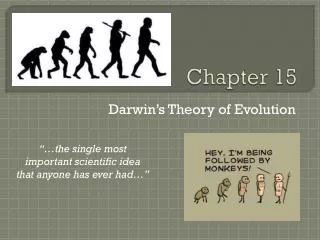
Chapter 15 Darwin’s Theory of Evolution “…the single most important scientific idea that anyone has ever had…”
15-1 The Puzzle of Life’s Diversity • Evolution: change over time • process by which modern organisms descended from ancient organisms • Do you remember what a theory is?
Voyage of the Beagle 1831- England Charles Darwin Recorded observations Collected data/specimens Proposed evolutionary theory about how life changes over time
Darwin’s Data • Diversity • Galapagos Islands- different plants/animals on each island • Patterns • Reproductive, habitats, etc. • Fossils: preserved remains/evidence of ancient organisms • Connected old and new
15-2 Ideas that shaped Darwin’s thinking • Old belief: Earth was “young” and hadn’t changed since life began • Discoveries in geology: • James Hutton • Geological change • Effects of natural forces (rain, wind) • Happens slowly/constantly • Charles Lyell • Wrote Principle’s of Geology • Earth has changed over time…could life?
Jean-Baptiste Lamarck Organisms adapt If you use it, it will stay (get passed on) If you don’t, it will go away Tendency toward perfection Inheritance of acquired traits*
Population Growth Thomas Malthus- economist More people are born than are dying Uncontrolled population growth = high competition for resources What makes some survive and others die?
15-3 Darwin Presents his case • 1859- publishes On the Origin of Species: • Evolution has been happening for millions of years and is still happening today • Mechanism of evolution = natural selection
Variation and Artificial Selection • Genetic variation found everywhere • Breeders use it to make “the best”: • Fastest horses • Plants with biggest fruit • Artificial selection: selection by humans for breeding of desired traits from the natural genetic variation of organisms
Evolution by Natural Selection Darwin questioned: How does “selection” happen in nature? Struggle for existence: competition among members of a species for food, living space, reproduction, etc.
Survival of the Fittest Process by which individuals better suited to their environment survive and reproduce most successfully Fitness: ability of an organism to survive and reproduce Adaptation: inherited characteristic that increases an organisms chance of survival (structural, physiological, behavioral, etc.)
Survival of the Fittest = Natural Selection Successful adaptations will increase fitness If you survive/reproduce, you pass on genes = more of those genes in nature
Descent with Modification Each living species has descended- with changes- from other species over time Common descent: all living things come from a common ancestor
Darwin’s Evidence #1 fossil record- organisms have come and gone but can be related/connected to current organisms
Darwin’s Evidence #2 • geographical distribution of living species- descent with modification • As organisms changed, they adapted to different habitats and spread out
Darwin’s Evidence #3 • homologous body structures: structures that have different mature forms in different organisms but developed from the same embryonic tissue • Ex: limbs (arms, wings, flippers) • Increased similarities = more closely related • Ex: bats and humans, birds and reptiles
Vestigal Structures Structures that serve no useful function Homologous structures that the organisms no longer needs Ex: whale “legs”
Darwin’s Evidence #4 similarities in embryology- many embryos look the same common cells growing in similar ways