Understanding Neutralization Reactions and Titration in Acid-Base Chemistry
Neutralization reactions occur when an acid and a base react in an aqueous solution, producing a salt and water. This essential type of chemical reaction is fundamental in acid-base chemistry. Titration is a technique used to determine the concentration of an unknown solution by adding a known concentration of a titrant until the equivalence point is reached, which is indicated by a color change of the indicator used. This process allows chemists to calculate the concentration of acids and bases effectively.

Understanding Neutralization Reactions and Titration in Acid-Base Chemistry
E N D
Presentation Transcript
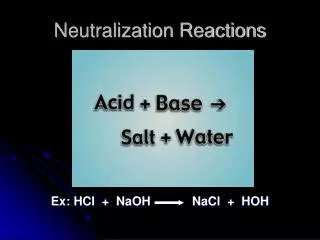
Acid-Base Reactions • Reactions in which an acid and a base react in an aqueous solution to produce a salt and water are generally called neutralization reactions.
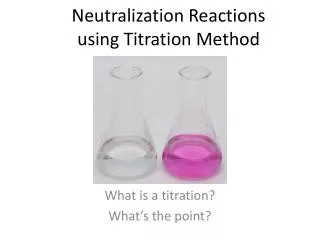
Titration • The process of adding a known amount of solution of known concentration to determine the concentration of another solution is called titration. • What is the endpoint of a titration? The point of neutralization is the end point of the titration.
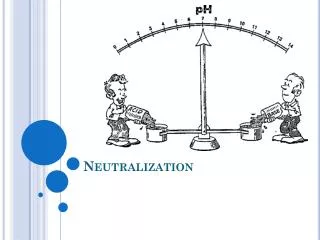
Titration • Add solution from the buret. • Reagent (base) reacts with compound (acid) in solution in the flask. • Indicator shows when exact stoichiometric(moles) reaction has occurred. (Acid = Base) This is called NEUTRALIZATION.
ACID-BASE REACTIONSTitrations HCl(aq) + NaOH(aq) --->NaCl(aq) + H2O(liq) acidbase Carry out this reaction using aTITRATION.
The solution of known concentration is called the standard solution. • Indicators are often used to determine when enough of the standard solution has been added to neutralize the acid or base. • The point at which the indicator changes color is the end pointof the titration.
Equivalence Point • When an acid and base are mixed, the equivalence pointis when the number of moles of hydrogen ions equals the number of moles of hydroxide ions.
ACID-BASE REACTIONSTitrations HCl(aq) + NaOH(aq) --->NaCl(aq) + H2O(liq) acidbase TITRATION calculations Macid • Vacid = Mbase • Vbase