Neutralization Reactions
Neutralization reactions occur when an acid reacts with a base to produce water and an ionic compound, typically resulting in a neutral pH of 7. For example, when hydrochloric acid (HCl) reacts with sodium hydroxide (NaOH), water and sodium chloride are formed. Another example includes phosphoric acid (H₃PO₄) reacting with potassium hydroxide (KOH). In everyday situations, antacids like magnesium hydroxide can neutralize excess stomach acid. Learn to balance these chemical equations and prepare for your chemistry unit test.

Neutralization Reactions
E N D
Presentation Transcript
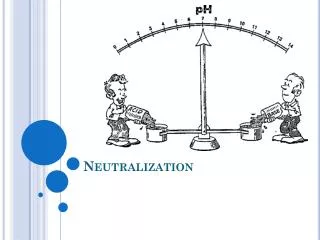
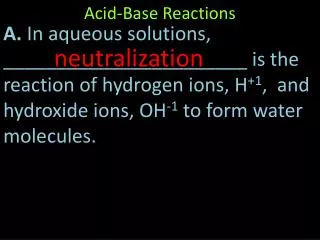
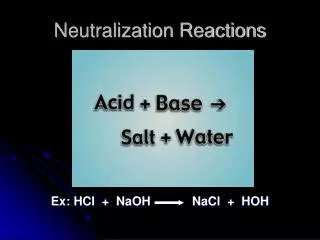
Neutralization Reactions Occur when an acid and a base react to form products that have a pH of 7
Predicting the Products of Neutralization Reactions • Acid + Base water + ionic compound • HCl + NaOH • H3PO4 + KOH Balance the Equations!
You suffer from an upset stomach. Your stomach acid is building up. (Hydrochloric acid). You reach for the antacid (Magnesium Hydroxide) • Will this neutralize your stomach acid? • Write the equation, with states, and balance it!
Homework: • P. 281 # 2-4 • Chapter 7 Review • P. 294 – p. 295 • #1-3, 5-9, & 11 Start Studying for the Chemistry Unit Test!