Understanding Inductive Predicates and the Curry-Howard Isomorphism in Coq
This document explores the concepts of inductive predicates in Coq, comparing unit and truth representations, and examining the Curry-Howard isomorphism which connects proofs and programs. It addresses the distinction between propositional logic and Coq's constructive logic, including the implications on proof extraction and program efficiency. Key topics include the definition of inductive types like `isZero` and `even`, the practical applications of tactics in Coq, and the nature of boolean types versus proposition types.

Understanding Inductive Predicates and the Curry-Howard Isomorphism in Coq
E N D
Presentation Transcript
Inductive Predicates • Unit vs True • Inductive unit : Set := tt : unit • Inductive True : Prop := I : True • Curry Howard Isomorphism • But Coq distinguish Proof and Program • Efficiency? • Proof Prevalence?
Propositional Logic • not = fun A : Prop => A -> False : Prop -> Prop • Inductive and (A : Prop) (B : Prop) : Prop := conj : A -> B -> A /\ B • Inductive or (A : Prop) (B : Prop) : Prop := or_introl : A -> A \/ B | or_intror : B -> A \/ B
Bool Vs Prop • bool is datatype of two members, true, false • Prop is primitive type in Coq, and True, False are two members in Prop • Coq use Constructive Logic, while P\/~P is not allowed • Issues • bool is decidable • Constructive logic allow us to extract program from proof • We can write program by proof a theorem, though maybe less efficient
First-Order Logic • forall and exists • forall is built-in • exists: • Inductive ex (A : Type) (P : A -> Prop) : Prop := ex_intro : forall x : A, P x -> ex P
Tactics • Tauto • Solve intuition logic, only unfold not • Intuition • Use tauto, and apply tactics • Intuition=intuition auto. • Firstorder • Extend tauto to firstorder logic • Trivial • Restricted auto • auto • Eauto • Auto using eapply, generate ‘_’
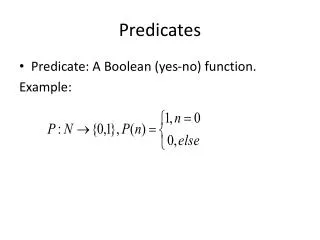
Basic dependant type • Inductive isZero : nat -> Prop :=| IsZero : isZero 0. • Inductive even : nat -> Prop :=| EvenO : even O| EvenSS : forall n, even n -> even (S (S n)). • Example of product: forall a:A,B