SlideServe
Menu
Préférences
© SlideServe · v2026

Exploring Career Development Techniques for Professional Growth

eamon avatar
18 diapositives · 313 Views · Sep 16, 2014

This comprehensive guide explores essential career development techniques and professional opportunities available for individuals seeking to enhance their career prospects. It covers educational requirements, including post-secondary options such as community colleges, universities, and technical schools. Additionally, it discusses the importance of certifications from organizations like AIA, NSPE, ASLA, and ASID. The significance of mentoring, entrepreneurial skills, and personal characteristics that contribute to success—such as organization, innovation, and risk-taking—are also highlighted.
Exploring Career Development Techniques for Professional Growth - slide 1
01 / 18Exploring Career Development Techniques for Professional Growth
1 / 17

Télécharger la présentation

Exploring Career Development Techniques for Professional Growth
Une image / un lien ci-dessous est fourni (tel quel) pour télécharger la présentation

Politique de téléchargement : le contenu du site vous est fourni TEL QUEL pour votre information et votre usage personnel ; il ne peut être vendu, concédé sous licence ni partagé sur d’autres sites sans l’accord de son auteur.Le contenu vous est fourni TEL QUEL, pour votre information et votre usage personnel uniquement. Téléchargez la présentation en cliquant sur ce lien. Lors du téléchargement, si vous ne parvenez pas à télécharger une présentation, l’éditeur a peut-être supprimé le fichier de son serveur.Pendant le téléchargement, si vous ne parvenez pas à obtenir une présentation, le fichier a peut-être été supprimé par l’éditeur.

F I N

Plus de contenu associé

Transcription de la présentation
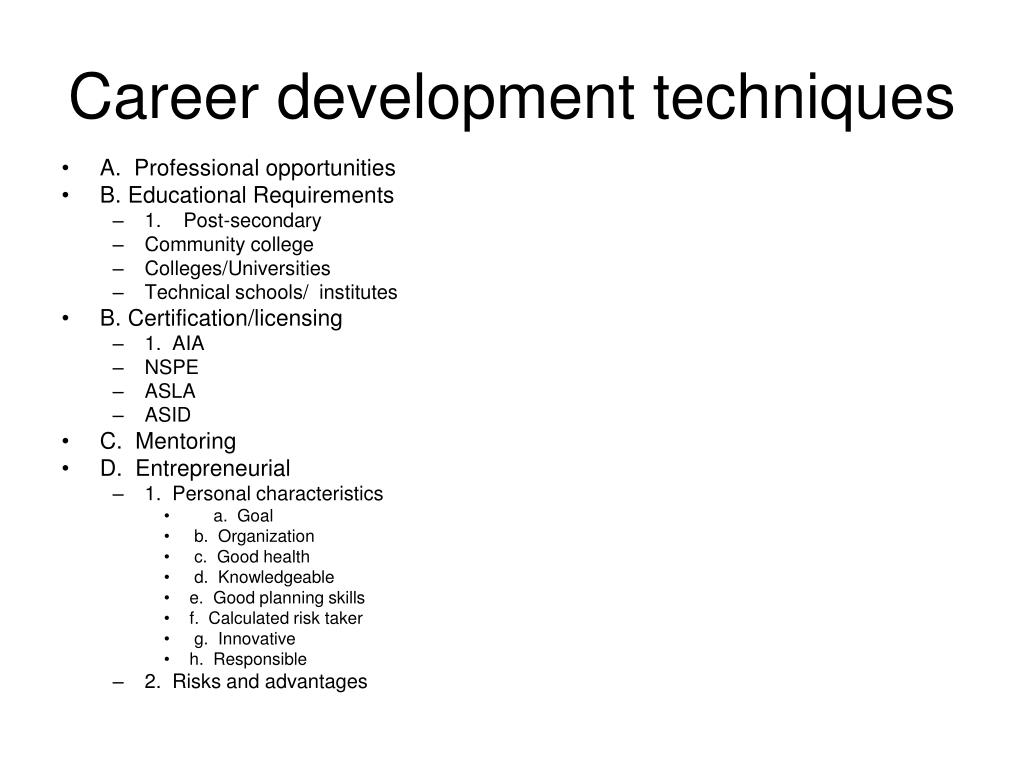
  1. Career development techniques • A. Professional opportunities • B. Educational Requirements • 1. Post-secondary • Community college • Colleges/Universities • Technical schools/ institutes • B. Certification/licensing • 1. AIA • NSPE • ASLA • ASID • C. Mentoring • D. Entrepreneurial • 1. Personal characteristics • a. Goal • b. Organization • c. Good health • d. Knowledgeable • e. Good planning skills • f. Calculated risk taker • g. Innovative • h. Responsible • 2. Risks and advantages

  2. 2.01 Explain employment opportunities, educational requirements, and job trends.

  3. Professional Oppurtunities • Trainings- • Professional Communities-

  4. Education • Post-Secondary Opportunities = after high school! • 1.Community College-An institution open to students upon completion of high school to obtain specialized training in certain fields, • 1.A An associate degree (2-year) • 1.B College credits for transfer toward a degree at a college/university. Government supported so cost is usually less than privately run schools.

  5. Education 2. Junior College-An institution that offers a 2- year degree program (an Associate Degree).

  6. Education 3.College/University-An institution of higher learning. Degrees vary depending on course of study. May be state supported or private funded.

  7. Education 4.Technical School-A school of specialized training. I.e.: computers, cosmetology, truck driving, etc.

  8. Tell a partner… • What type of school will you go to for your career? • Do you have more than one option? • Why did you choose that type of education?

  9. Certification/Licensing • Do you have to have a certification or a license to work in your future career?

  10. Certification/Licensing( these are your 2.01 vocab:10-13) • 10. AIA- American Institute of Architects- An organization that promotes high professional standards among architects. Members must satisfy ongoing education and training requirements. • 11. NSPE-National Society of Professional Engineers- An organization that promotes high professional standards among engineers. Members are required to have a high level of preparation service under a professional engineer, and ongoing continuing education and training.

  11. Certification/Licensing( these are your 2.01 vocab:10-13) • 12.ASLA-American Society of Landscape Architects- An organization that promotes high professional standards among landscape architects. Members are required to continually update their education and knowledge. • 13.ASID-American Society of Interior Designers- An organization that promotes high professional standards among interior designers. Members are required to have a high level of preparation and ongoing continuing education and training.

  12. Research Each organization… • Divide into 4 groups, make a powerpoint or prezi to answer your groups questions

  13. AIA • 1. What does AIA Stand for? • 2.What is the AIA logo? • 3. What event is AIA hosting November 14-16? Where is it located? • 4.What is the goal of AIA? • 5. What are the closest AIA components/chapters? • 6.What is AIA Intern Development program? How does it help students? • 7. How would someone benefit from being a AIA membership?

  14. NSPE • 1. What does NSPE stand for ? • 2. What is the NSPE logo? • 3.When is the NSPE annual meeting for 2013? Where is it located? • 4. What is the mission of NSPE? • 5. What are the 5 reasons that NSPE says you should get a license? • 6. How would someone benefit from a membership at NSPE?

  15. ASLA • 1. What does ASLA stand for? • 2. What is ASLA’s logo? • 3.Where and when is ASLA’s annual meeting? • 4.What is the mission of ASLA? • 5.Who is the president and president elect of ASLA’s North Carolina Chapter? • 6. What are the 3 types of graduate programs that you will need in this career? • 7. How would someone benefit from a membership at ASLA?

  16. ASID • 1. What does ASID stand for? • 2. What is ASID logo? • 3. What is IBS 2013? Where is it going to be held? • 4. What is the core of ASID? • 5. What are the 2 closest chapters of ASID? • 6. What are the 5 specialty credentials you can get as a designer? What do they stand for? • 7.How would someone benefit from a ASID membership?

  17. Mentoring! • As a new professional it is good to have a mentor.. • A mentor should be someone who has… • Good work ethics • Experience in the field • Leadership skills • Positive attitude