2D cross-hole inversion
This text delves into the application of resistivity surveys, focusing on 2D and 3D inversion techniques for subsurface investigations, including sinkhole collapse detection and geological features mapping. It discusses methodologies from notable studies, such as cross-hole surveys for iron prospecting and brine tracer injection monitoring. The advantages of resistivity surveys include their simplicity and cost-effectiveness, but drawbacks such as model sensitivity and noise interference are also highlighted. Ongoing advancements in modeling are aimed at addressing these challenges.
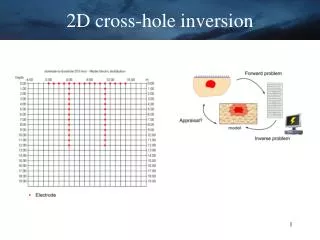

2D cross-hole inversion
E N D
Presentation Transcript
Sinkhole collapses detection Source: Deceuster, Delgranche, Kaufmann, Faculté Polytechnique de Mons
Sinkhole collapses detection Source: Deceuster, Delgranche, Kaufmann, Faculté Polytechnique de Mons
Mining application Cross-hole survey for iron prospection in Heiba (China) Source J. Zhe, University of Adelaide
Brine tracer injection (10 days after) Injection: 300 l in 2 days (brine resistivity 0.05 ohm.m) Courtesy of Hyunday Institute of Construction Technology, Korea
3D fluide migration monitoring Source: Doug La Brecque
3. Survey strategies and interpretation How well-resolved are the models? A simple test…
DOI index approach Homogeneous reference models: qA= average app. resistivity * 5 qB= average app. resistivity / 5
DOI Index Approach Using the DOI index: electrical imaging in marine environment, Denmark Source: Marescot, L. and Loke, M.H, SAGEEP 2004, Colorado Springs
DOI index approach Using the DOI index: electrical imaging in marine environment, Denmark Source: Marescot, L. and Loke, M.H, SAGEEP 2004, Colorado Springs
Summary example:Looking for paleo-valleys Source: Marescot et al., 2003, Eclogae Geol. 96
Resistivity Mapping Apparent resistivity map
P6 P5 2D resistivity tomography
Advantages • Resistivity surveys are simple and robust • Non expensive • Allows for a rapid qualitative mapping of the underground • Can be used for a 2D or 3D investigation of the subsurface • Resistivity contrasts are often present in geological deposits
Drawbacks and needs for further developments • Sensitive to non-unicity in the modeling solutions • Quantitative aspects still need to be developed but significant progresses are currently made (3D inversion) • Sensitivity to noise and metallic bodies such as pipes (urban area) • Usually need for a galvanic coupling • Progress needed for better defining the resistivity properties of geological material (petrophysics) • Method mainly sensitive to the fluid in rocks. Good for hydrology but a problem in archeology and soil investigations: the signature of a feature can dramatically change with the seasons or weather conditions!