Density in Chemistry: Mass, Volume, and Common Units
Learn the basics of density in chemistry from Mrs. Coyle's lesson. Understand how density is calculated using mass and volume, common units like g/mL, and its relation to temperature. Explore the densities of common substances and the unique density of water. Remember, density is an intensive property independent of the sample's size.

Density in Chemistry: Mass, Volume, and Common Units
E N D
Presentation Transcript
Density Chemistry Mrs. Coyle
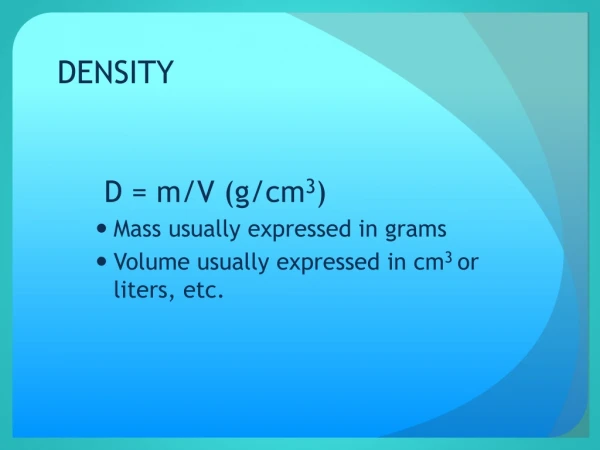
Density Density= Mass Volume D= m V
Mass • Mass: Amount of matter in a substance. • Don’t confuse with weight. • Weight: the force with which the earth pulls on the substance.
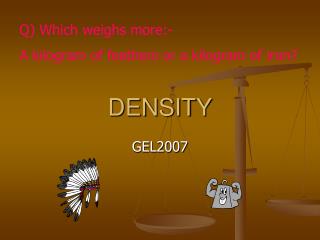
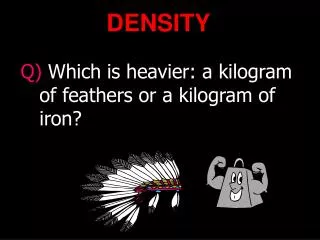
Question Which weighs more? 50 kilograms of iron Or 50 kilograms of feathers
Question Which has a greater density? iron Or feathers
Common Units of Density Density= Mass Volume g/mL = g/cm3 kg/m3 1 cm3=1 mL 1 dm3=1L
Density as a Function of Temperature For most substances, as temperature increases the volume increases and as a result the density decreases.
Density of Water At 4oC water has its maximum density of 1g/cm3 Convert to kg/m3: 1000kg/m3
Note • Density is an intensive physical property. (Does not depend on amount of matter in the sample)