Understanding Essential Nutrients: Carbs, Fats, Proteins, Vitamins, Minerals, and Water
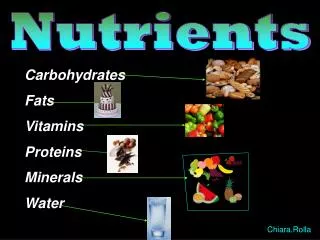
Essential nutrients play a crucial role in our health and well-being. Carbohydrates, both simple and complex, provide energy, while fats, categorized as unsaturated, trans, and saturated, are vital for fullness and caloric intake. Proteins support growth and maintenance of body systems, including muscles and organs. Vitamins A, C, D, and B contribute to various bodily functions, and minerals like calcium and zinc are essential for immune and muscular health. Fiber aids digestion, and water is vital for survival. Learn more about these nutrients and their sources.


Understanding Essential Nutrients: Carbs, Fats, Proteins, Vitamins, Minerals, and Water
E N D
Presentation Transcript
Important Nutrients By Angus
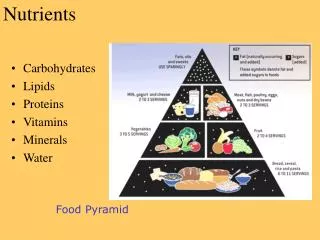
Carbs • two types • Simple (simple sugars in sugar) • Complex (starches in grains) • Gives you energy • Some cause blood sugar to raise quicker • Lollipops, ice cream, milk.
Fats • three types: • Unsaturated (good) • Trans (worst) • Saturated (bad) • Makes you fat • Fills you up fast • Children get 30% of their daily calories • Good and Bad • Butter, milk, ice cream and chips
Protein • Protein helps with growth and maintenance of many systems in the body • Including: • Cardiac Muscles (heart) • Other muscles • Organs • Protein can be found in meats, eggs and milk
Vitamins • There are three primary types of vitamins • D (helps bones) • A ( helps night vision) • C (helps healing) • B (helps make energy) • They are in liver fruits and vegetables
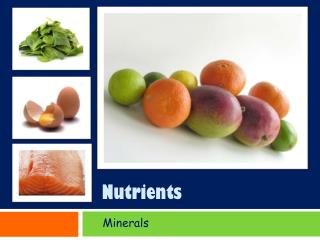
Minerals • Two types: • macro (calcium, sodium, potassium, etc…) • trace (iron, zinc, fluoride, etc…) • Zinc helps your immune system • Potassium maintains your muscles and nerves • broccoli, cheese, eggs, cereals, OJ
Fiber • two types • Soluble (helps lower blood cholesterol) • Insoluble (helps digestive system) • Women need twenty grams per day • Men need thirty • In cereal, nuts, apples, bananas etc…
Water • Helps immune system • Helps excretory system • No water = No life • Couldn’t survive two days without it • Makes up more than half of weight • In: water
Bibliography • http://kidshealth.org/kid/stay_healthy/food/fat.html • http://kidshealth.org/kid/stay_healthy/food/carbohydrates.html • http://kidshealth.org/kid/stay_healthy/food/vitamins.html • http://kidshealth.org/kid/stay_healthy/food/protein.html • http://www.hsph.harvard.edu/nutritionsource/what-should-you-eat/fiber/ • http://kidshealth.org/kid/stay_healthy/food/minerals.html