
Embryonic Development in Animals: Cleavage, Gastrulation, Germ Layers, Organogenesis
E N D
Presentation Transcript
Animal Development Chapter 47
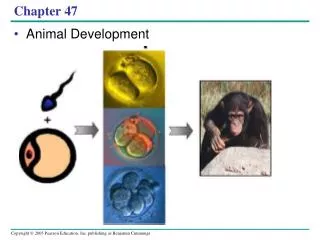
Cleavage • A period of rapid cell division after fertilization • Skips the G1 and G2 phases • No growth during this period, just division • Includes the following developmental stages • Zygote • Blastomeres • Morula • Blastula (with blastocoel) • IVF Animation
Gastrulation • Rearrangement of blastula cells to form a gastrula with three distinct germ layers • Accomplished by change in: • Cell motility • Cell shape • Cell adhesion to other cells & extracellular matrix
Germ Layers • Ectoderm • Outer layer • Endoderm • Lines embryonic digestive tract • Mesoderm • Partly fills the space between the endoderm & ectoderm
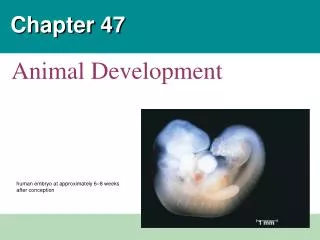
Organogenesis • The germ layers work together to develop into the rudimentary organs • Can be seen by folds, splits, and clustering of cells in localized tissues • By 8 weeks in humans the fetus has all the basic versions of their organs
First Organs in Chordates • Notochord • Formed from mesoderm • Future position of the vertebral column • Neural tube • Becomes the central nervous system • Neural crest is formed along the border which becomes the peripheral nerves, teeth, skull, and more (aka: 4th germ layer) • Somites • Lateral strips along notochords, in pairs • Forms vertebrae • Associated with axial muscle development
Adaptation in Amniotes • A moist environment is needed for the developing embryo • Amniotic fluid is the solution: • Shelled eggs for birds, reptiles, and monotremes • Uterus for marsupial and eutherian mammals
Adaptations in Mammals • Internal fertilizition • Small eggs with little amounts of stored nutrients • Reliant on a uterus to provide nutrients from the mother • Slow cleavage (first division done after ~36 hours)
Human Embryo Development • Blastocyst has reached the uterus • The trophoblast begins to implant into the endometrium by secreting catabolic enzymes • Trophoblast expands into maternal tissues via mitosis to gain nutrients from her blood supply • Implantation in completed and gastrulation begins • The end of gastrulation has arrived and the embryo is now surrounded by extraembryonic membranes
Extraembryonic Membrane in Humans • Chorion: surrounds all extraembryonic membranes & provides gas exchange • Amnion: provides the protective layer around the amniotic fluid • Yolk sac: found below the embryo this cavity is where blood cells are formed which travel to the embryo • Allantonis: part of the umbilical cord in the form of blood vessels to move nutrients and waste
The Fate of Embryonic Cells • This is dependent on the movement of cells to allow for changes in cell shape & function • Cells move by using the cytoskeleton to crawl from one location in the embryo to another • This movement is regulated by ECM and secreted glycoproteins • Fibronectin: which provides anchorage • Cell adhesion molecules: bind to the CAM’s on other cells for tissue building • Cadherins: helps with tight junctions
The Fate of Embryonic Cells • Induction: A group of embryonic cells has the ability to influence the formation of another group resulting in specialized cells (by expressing only specific genes) • Fate Mapping: Embryonic cells have a specific fate before gastrulation occurs (as cells mature they are limited in what they can become) • Cellular Asymmetry: position of the nuclei in the sperm & egg may play in role in determining developmental axes
The Fate of Embryonic Cells • Restriction to cell potency: in humans embryonic cells are totipotent until the 16 cell stage when they are determined to be either blastocyst or trophoblast based on location • Inductive signals: embryonic cells will be influenced by other about their final fate through gastrula organizers • Ex: dorsal lip is an organizer the controls the development of notochord, neural tube, and more • Brain Pop: Stem Cells