Download
1 / 1
10 likes | 124 Vues
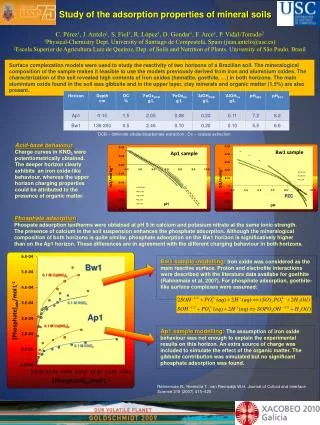
This study explores the adsorption properties of Brazilian mineral soils by employing surface complexation models to analyze two horizons. The mineralogical assessment indicates significant iron oxide content, including hematite and goethite, while gibbsite and organic matter are present in the upper layer. Potentiometric charge curves reveal different charging behaviors in each horizon. Phosphate adsorption isotherms obtained at pH 5 demonstrate that calcium enhances phosphate adsorption, with notable differences in adsorption rates between the two horizons, highlighting the role of iron oxide and organic matter in reactivity.

E N D
Study of the adsorption properties of mineral soils C. Pérez1, J. Antelo1, S. Fiol1, R. López1, D. Gondar1, F. Arce1, P. Vidal-Torrado2 1Physical-Chemistry Dept. University of Santiago de Compostela. Spain (juan.antelo@usc.es) 2Escola Superior de AgriculturaLuiz de Queiroz, Dep. of Soils and Nutrition of Plants. University of São Paulo. Brasil PZC Surfacecomplexationmodelswereusedtostudythereactivity of twohorizons of a Braziliansoil. Themineralogicalcomposition of thesamplemakesitfeasibleto use themodelspreviouslyderivedfromiron and aluminiumoxides. Thecharacterization of thesoilrevealedhighcontents of iron oxides (hematite, goethite, …) in bothhorizons. Themainaluminiumoxide found in thesoilwasgibbsite and in theupperlayer, clayminerals and organicmatter (1.5%) are alsopresent. Bw1 0.1 M Ca(NO3)2 0.1 M KNO3 Ap1 0.1 M Ca(NO3)2 0.1 M KNO3 *DCB – dithionite-citrate-bicarbonate extraction ; Ox – oxalate extraction Acid-base behaviour Charge curves in KNO3were potentiometricallyobtained. Thedeeperhorizonclearly exhibitsaniron oxide-like behaviour, whereastheupper horizonchargingproperties couldbeattributedtothe presence of organicmatter. Phosphateadsorption Phospateadsorptionisothermswereobtained at pH 5 in calcium and potasiumnitrate at thesameionicstrength. Thepresence of calcium in thesoilsuspensionenhancesthephosphateadsorption. Althoughthemineralogicalcomposition of bothhorizonsis quite similar, phosphateadsorptiononthe Bw1 horizonissignificativelyhigher thanonthe Ap1 horizon. Thesedifferences are in agreementwiththedifferentchargingbehaviour in bothhorizons. Bw1 samplemodelling:Iron oxide wasconsidered as themain reactive surface. Proton and electroliteinteractionsweredescribedwiththeliterature data availabeforgoethite (Rahnemaie et al, 2007). Forphosphateadsorption, goethite-likesurfacecomplexeswereassumed: Ap1 samplemodelling:Theassumption of iron oxide behaviourwasnotenoughtoexplainthe experimental resultsonthishorizon. An extra source of chargewasincludedtosimulatetheeffect of theorganicmatter. Thegibbsitecontributionwassimulatedbut no significantphosphateadsorptionwasfound. Rahnemaie R., Hiemstra T., van Riemsdijk W.H. Journal of Colloid and Interface Science 315 (2007) 415–425