Understanding Temperature Effects on Borosilicate Glass Structures Through NMR Spectroscopy
Borosilicate glasses, rich in silicon, boron, and aluminum, are essential in high-tech materials, from fiber composites to LCD screens. However, the atomic-scale structural changes that occur with temperature are not well understood. Researchers, led by Jonathan F. Stebbins from Stanford University, are employing high-resolution Nuclear Magnetic Resonance (NMR) spectroscopy to study these changes. Their findings reveal how increased temperatures facilitate the conversion of boron coordination, impacting the properties of glasses. This groundbreaking work informs material science and helps in developing new oxide glass applications.

Understanding Temperature Effects on Borosilicate Glass Structures Through NMR Spectroscopy
E N D
Presentation Transcript
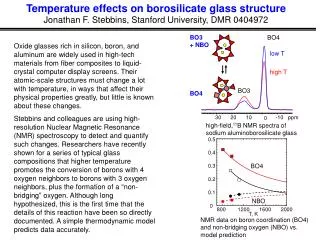
Temperature effects on borosilicate glass structure Jonathan F. Stebbins, Stanford University, DMR 0404972 0.5 0.4 0.3 BO4 0.2 NBO T, K 0.1 0 800 1200 1600 2000 BO3 + NBO BO4 Oxide glasses rich in silicon, boron, and aluminum are widely used in high-tech materials from fiber composites to liquid-crystal computer display screens. Their atomic-scale structures must change a lot with temperature, in ways that affect their physical properties greatly, but little is known about these changes. Stebbins and colleagues are using high-resolution Nuclear Magnetic Resonance (NMR) spectroscopy to detect and quantify such changes. Researchers have recently shown for a series of typical glass compositions that higher temperature promotes the conversion of borons with 4 oxygen neighbors to borons with 3 oxygen neighbors, plus the formation of a “non-bridging” oxygen. Although long hypothesized, this is the first time that the details of this reaction have been so directly documented. A simple thermodynamic model predicts data accurately. low T high T BO3 BO4 30 20 10 -10 ppm 0 high-field,11B NMR spectra of sodium aluminoborosilicate glass NMR data on boron coordination (BO4) and non-bridging oxygen (NBO) vs. model prediction
Structure and properties of oxide glasses: career development for the high-tech materials industry JonathanF. Stebbins, Stanford University, DMR 0404972 Their program trains students with diverse backgrounds in the science of oxide glass structure and properties. Three recent examples include T.J. Kinczenski, who finished his Ph.D. in Spring of 2005 and has gone on to a career in the research lab of Corning, Inc.; Lin-Shu Du, who was supported in this program as a postdoc and who left in early 2006 for a research position at a chemical company developing amorphous materials for the electronics industry (as well as many other products); and Jingshi Wu, a talented young woman with a mineralogy background who is interested in high-tech oxide materials and who is currently working in their Ph.D. program.