

SlideServe
Menu
Préférences
© SlideServe · v2026

Vladimir Lenin

fai avatar
14 diapositives · 2K Views · Jul 31, 2014

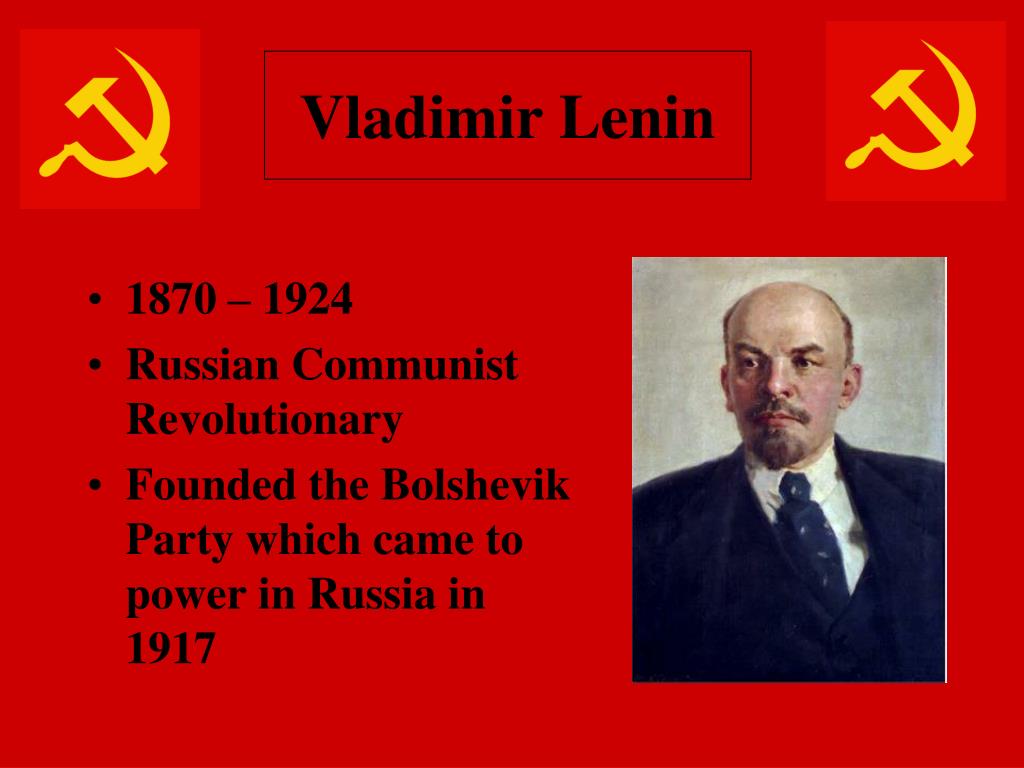
Vladimir Lenin. 1870 – 1924 Russian Communist Revolutionary Founded the Bolshevik Party which came to power in Russia in 1917. Major Works. What is to be Done? (1902) Imperialism: the Highest Stage of Capitalism (1916). Key Concept: Imperialism.
Vladimir Lenin - slide 1
01 / 14Vladimir Lenin
1 / 17

Télécharger la présentation

Vladimir Lenin
Une image / un lien ci-dessous est fourni (tel quel) pour télécharger la présentation

Politique de téléchargement : le contenu du site vous est fourni TEL QUEL pour votre information et votre usage personnel ; il ne peut être vendu, concédé sous licence ni partagé sur d’autres sites sans l’accord de son auteur.Le contenu vous est fourni TEL QUEL, pour votre information et votre usage personnel uniquement. Téléchargez la présentation en cliquant sur ce lien. Lors du téléchargement, si vous ne parvenez pas à télécharger une présentation, l’éditeur a peut-être supprimé le fichier de son serveur.Pendant le téléchargement, si vous ne parvenez pas à obtenir une présentation, le fichier a peut-être été supprimé par l’éditeur.

F I N

Plus de contenu associé

Transcription de la présentation
  1. Vladimir Lenin • 1870 – 1924 • Russian Communist Revolutionary • Founded the Bolshevik Party which came to power in Russia in 1917

  2. Major Works • What is to be Done? (1902) • Imperialism: the Highest Stage of Capitalism (1916)

  3. Key Concept: Imperialism • Elaborated upon Marx’s assertion that monopolies are a natural tendency in developed capitalist economies and will prove capitalism’s undoing* • Capitalist economies postponed social and economic chaos and their inevitable demise through colonization • Colonial markets absorbed excess production that could not be sold to the impoverished working class in the mother country • Imperialism and colonialism are a consequence of monopoly capitalism, or “Imperialism is the monopolystage ofcapitalism.” *see next slide for how this process works

  4. Marx and Monopoly Capitalism • Marx believed that various tendencies in capitalism would promote class conflict. • processes of capital accumulation and competition would combine to produce monopoly capitalism and ever more extreme crises of capitalism, • The progressive development of technology would bring deskilling of jobs creating a more homogenised and potentially united labour force; • the relative gap in wealth between the dominant and subordinate classes would steadily increase; propelling processes of class conflict towards an ultimate social revolution.

  5. Lenin’s Marxism: Key Concepts • Communist Revolution could occur in a backward peasant country such as Russia which had only just begun to emerge from its pre-capitalist stage • “Sometimes--history needs a push.”

  6. A small elite of disciplined and determined revolutionaries “who make revolutionary activity their profession” could lead the masses in revolution

  7. Lenin’s Quotable Quotes • “Fascism is capitalism in decay” • “The goal of socialism is communism.” • “While the State exists there can be no freedom; when there is freedom there will be no State.” (What does he mean by this?) Think Marx’sSuperstructure – the legal, political, and social institutions which reflect, express, and consolidate the relations of economic power that flow from the mode of production practiced by a society.

  8. Lenin Dies January 24, 1924:What would He have Done?

  9. Enter Stalin: Building Communism

  10. Don’t Forget Maoism

  11. Critique • Many, on the right in particular, argue that Marxism goes against human nature. • How important is class and inequality in social life? In many societies, kinship, religion, and ethnicity seem to have provided stronger connections than has class. • Marx’s framework cannot deal adequately with other dimensions of inequality. To conceptualize a society as mode of production is inevitably to privilege economic relations over other aspects of inequality. There is more than simply the class struggle going on in society. • At the international level, nationalism trumps working class solidarity.