Understanding Crystal Planes and Holography: Diffraction Patterns and Interference Explained
60 likes | 181 Vues
This document explores the properties of cubic crystals and their crystal planes, focusing on the spacing of planes which is critical in understanding diffraction. It further includes the principle and formation of holograms, detailing how interference patterns are recorded and how virtual images are created when light interacts with holograms. Also presented are constructs of constructive interference of waves, showcasing practical applications in optics, such as resolving images from closely spaced light sources according to Rayleigh's criterion.


Understanding Crystal Planes and Holography: Diffraction Patterns and Interference Explained
E N D
Presentation Transcript
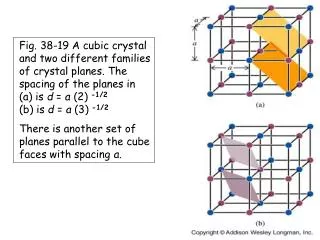
Fig. 38-19 A cubic crystal and two different families of crystal planes. The spacing of the planes in (a) is d = a (2) -1/2(b) is d = a (3) -1/2 There is another set of planes parallel to the cube faces with spacing a.
Fig. 38-20 Diffraction pattern formed by aperture w diam = D
Fig. 38-23 (a) A hologram is the record on film of the interference pattern formed with light from the coherent source and light scattered from the object. (b) Images are formed when light is projected through the hologram. The observer sees the virtual image formed behind the hologram.
Fig. 38-24 (a) Constructive interference of the plane and spherical waves occurs in the plane of the film at every point Q for which the distance bm > bo by ml. (b) When a plane wave strikes a transparent positive print of the developed film, the diffracted wave consists of a wave converging to P’ and then diverging again, and a diverging wave that appears to originate at P.
Fig. 38-26 (Exercise 38-36) Two light sources a and b produce images at c that are just resolved according to Rayleigh’s criteria.