Scintillating Fiber Tracker DAQ Test at KEK Beam Line: UniDAQ Software Development
This project involves testing the SciFi tracker with a 1T solenoid magnetic field at KEK-PS, utilizing newly developed Cryostat with Cryocooler and VLPC cassettes. The UniDAQ software, developed by KEK, will be used for data acquisition, with a focus on Unix-based systems and network distribution. The system overview includes backplane and control modules, VME bus, AFEII boards, and integration with VME ADC/TDC modules. Tasks for the KEK beam test include extending the slow controller for AFEII boards, merging data, and establishing event numbering. The project aims to achieve event buffering and trigger requirements for the MICE experiment.


Scintillating Fiber Tracker DAQ Test at KEK Beam Line: UniDAQ Software Development
E N D
Presentation Transcript
Tracker DAQ Makoto Yoshida (Osaka Univ.) MICE meeting @ Frascati 2005/6/27
KEK beam test • Test for the SciFi tracker with 1T solenoid magnetic field • p/p/m test beam line in KEK-PS • Slow extraction with 2-sec flat top in 4-sec cycle • Typically, 1000 particles in a beam spill • Newly developed Cryostat with Cryocooler • 2 VLPC cassettes embedded • Newly developed buffer module, VLSB • 4 VLSB modules for 4 AFEII boards
DAQ Software for KEK beam test • Will use Unix-based DAQ programs • “Unidaq” developed by KEK • http://www-online.kek.jp/~online/Unidaq/ • A lot of experience at the KEK beam tests • Work on Linux PC • Network distributed system • Transport data via NOVA buffer manager • Processes can be distributed among PCs on the network. • An Event Builder • Collectors for TOF etc. and VLPC
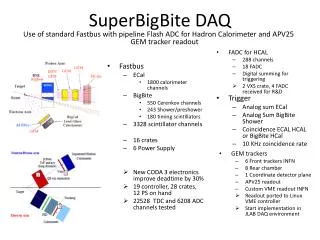
System Overview Linux PC VLPC backplane VME BUS 6U AFE II (L) 8x64 ch PCI-VME VLPC Cassette #1 Slow Control 1553 1024 ch AFE II (R) 8x64 ch SASeq #1 AFE II Control 8x64 ch AFE II (L) SASeq #2 VLPC Cassette #2 VME ADC/TDC 1024 ch AFE II (R) 4 8x64 ch LVDS-VME #1 VLPC Cryostat 4 LVDS-VME #2 4 Serialized ADC DATA LVDS-VME #3 4 PMTs LVDS-VME #4 4x8bit = 32 bit / board
Status • Setup LinuxPC with Bit3 VME interface at Fermilab in Dec. 2005 • Start porting the Windows VB routines to C codes on Linux PC • Successful readout pedestal data on a AFEII board in the end of May. • Initialization AFE boards via 1553 • Control SASeq • Readout buffer module, VLSB • GUI is prepared for the test • VME ADC and TDC modules have been tested in May KEK beam test to readout TOF, ACC and other beam counters in UniDAQ framework
Tracker DAQ at Fermilab Backplane AFEII Cryocooler Bit3 SASeq 1553 VLSB
VME ADC/TDC at KEK beam test multi-event ADC (CAEN V792) Multi-hit multi-event TDC (CAEN V1290) UK colleagues provides VME ADC/TDC
To do for KEK beam test • Extend slow-controller to handle 4 boards of AFEII • Implement AFEII readout routines on UniDAQ framework • Merge AFEII data with the other ADC/TDC data • Integration test at Fermilab • Time stamp of integration window on Trip chip • Tracker prototype will be shipped from UK in July • LED and Cosmic-ray data taking • Setup the system in KEK in Aug.
KEK beam test triggering scheme • Take coincidence of TOF counters • Check the timing with charge integration window on Trip chip • Trip has 48 x 132ns time slots • Distribute trigger to CAMAC and VME modules Trip integration window VLPC analog TOF coincidence Event trigger Dt : relative timing of trigger to integration window
Trigger (cnt’d) 21 usec 132 ns x 53 = 6996 ns 396 ns x 12 = 4752 ns Live time = 132 ns x 36 / 21 usec = 23% SASeq trig trig DG2020 AFE Trig + CLK TOF Trig sync
To do for MICE • Event-buffering in VLSB • Need to trigger 1MHz (1k muons in 1msec from ISIS) • Implement zero suppression scheme • Bench mark test of readout speed • Establish event numbering scheme / synchronization to the other counters
Data Rate in KEK test • Prototype has 2048ch readout channels • Beam structure @ p2 beam line: continuous 1000 muons / 2 sec • AFEII VLSB (VME LVDS SERDES Buffer) • 2 Bytes / channel • 20 bits @ 53MHz (multiplex 2 channel = 10bits + 10bits) • 64 x 1/53MHz ~ 1 msec for a trigger • VLSB VME bus PC • Measured Transfer rate by KEK-online group with Bit3 • 23MB/s in DMA mode • 2MB/s in PIO mode • 4MB / 4-sec-spill • Need to transfer 4kBytes in 1 msec w/o buffering • In case of zero suppression by DISCR, data rate could be reduced to ~1/10
Summary • We are preparing stand-alone DAQ system for tracker • VLPC readout • VME ADC/TDC • Not yet on slow-control • To fit to MICE case • Need event buffering (~1k muons / 1msec) • Need trigger / event numbering scheme