
Chi Squared Test
E N D
Presentation Transcript
Why Chi Squared? • To test to see if, when we collect data, is the variation we see due to chance or due to something else?
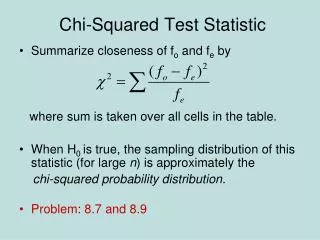
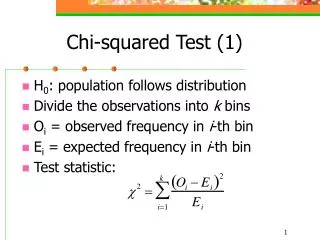
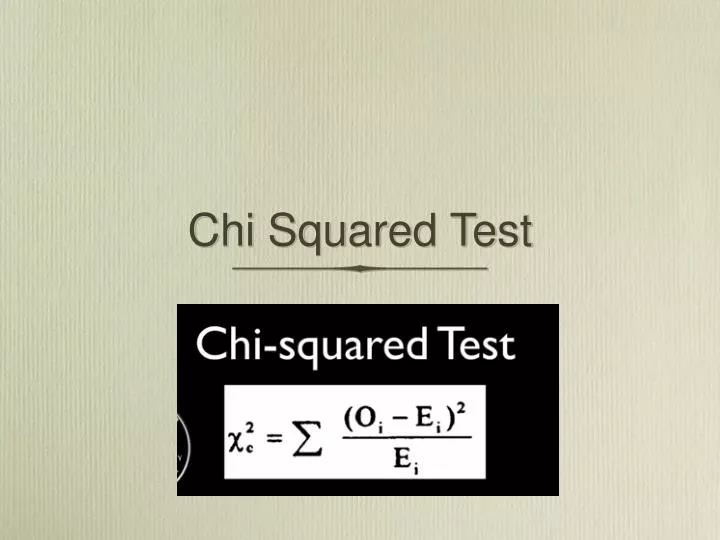
This is the Chi Squared Test Formula • Greek letter “X” is “Chi” • Don’t get confused- X2 is the name of the whole variable- you don’t have to ever take the square root of it or solve for X.
Coin Flipping Example • If you flip a coin 100 times and get this data: • 62 Heads • 38 Tails • The question we wonder about this data: • Is this due to chance? Or. . . • Is this not due to chance? • For example: • Perhaps there something wrong with the coin? • Perhaps there is something wrong with the way I am flipping the coin, etc.? • Chi Squared test lets us answer this!!
Null Hypothesis • The Chi Squared Test begins with the Null Hypothesis • The Null Hypothesis says: There is no significant statistical difference between the observed and expected frequencies (i.e. the differences we see are simply due to chance). • For a coin flipping experiment: • The expected values are 50 heads, 50 tails. • The observed values are 62 heads, 38 tails. • Question we are trying to answer: are the observed values due to chance or. . . not due to chance?
Degrees of Freedom and Critical Values • We need to define and understand these terms before we can use the Chi Squared test. • The whole point of a Chi Squared test is to either reject or “fail to reject” (accept) the Null Hypothesis. • Key is to exceed or not exceed your critical value. • But first we have to figure out which number it is in this chart.
Degrees of Freedom • Because we are comparing outcomes, we need at least two outcomes in our experiment. • We are flipping coins so we have two outcomes- heads or tails. • To get degrees of freedom we simply subtract one from the two possible outcomes. 2-1= 1 • Therefore, in this experiment we have 1 degree of freedom
Critical Values • Next thing you are looking for is a critical value. • We will always use p =0.05 value. • This means we are 95% sure we are either “failing to reject” theNull Hypothesis or “rejecting” our Null Hypothesis. • Critical Values can vary. If we want a higher degree of certainty that our results are true, we can use p= 0.01 value and then we would have 99% certainty, but 95% certainty is used by most scientists. • For 1 degree of freedom at p=.05 the critical value = 3.84.
Null Hypothesis • Null Hypothesis says: • There is no significant statistical difference between the observed and expected frequencies (i.e. the differences we see are simply due to chance). • We either reject or “fail to reject” (accept) the null hypothesis. • Reject the Null Hypothesis: This means there is a statistical difference between the observed and expected frequencies • Fail to Reject (accept) the Null Hypothesis: This means there is no statistical difference between the observed and expected frequencies • In this case the critical value is 3.841 • If your Chi Squared is greater than 3.841 you reject the Null Hypothesis • Therefore, there issomething aside from chance that is causing us to get more heads than tails. • If your Chi Squared is less than 3.841 you “fail to reject” (accept) the Null Hypothesis. • This is usually what happens unless you have something that is impacting your results
Practice- Coin Toss • 50 tosses • Expected: Heads: 25 Tails: 25 • Observed: Heads: 28 Tails: 22 • Do it for heads • Do it for tails • What is our Critical Value? • 2-1 = 1 • 3.84 • If our Chi Squared is greater than the critical value we reject our Null Hypothesis • If our Chi Squared is less than the critical value we “fail to reject” (accept) our Null Hypothesis • This means there is no statistical significance between what we observed & what we expected. What we got is due to chance- nothing’s weird about the coins or the way we tossed them.
Practice- Dice • 36 dice • Expected: 6 of each • Observed:
Practice- Dice • Chi Squared • Degrees of Freedom • 6-1=5 • Critical Value: 11.07 • “Fail to reject” (accept) the Null Hypothesis • No difference between obs and exp • What we see is due to chance!