Advanced Semiclassical Action Quantization in Fuzzy Mathematics
This document explores the advanced principles of semiclassical action quantization as established through the Einstein-Brillouin-Keller theory and later developments from Bohr, Sommerfeld, and Wilson. It discusses how fuzzy mathematics plays a crucial role in understanding quantization, particularly in systems where caustics occur at turning points. The paper highlights the correct semiclassical action quantization conditions based on the Maslov Index, distinguishing different scenarios such as rotations, tunneling, and librations, ultimately demonstrating their capability to yield remarkably accurate results in quantum mechanics.

Advanced Semiclassical Action Quantization in Fuzzy Mathematics
E N D
Presentation Transcript
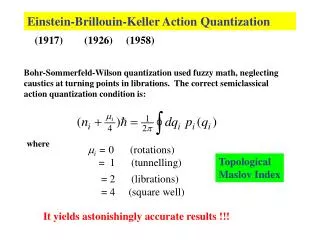
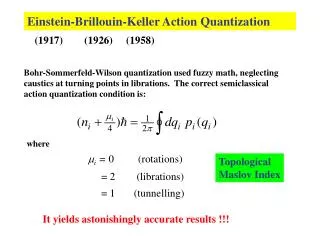
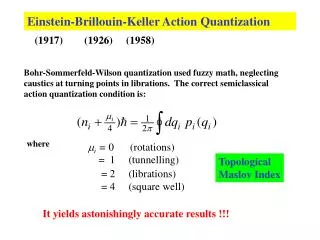
Einstein-Brillouin-Keller Action Quantization (1917) (1926) (1958) Bohr-Sommerfeld-Wilson quantization used fuzzy math, neglecting caustics at turning points in librations. The correct semiclassical action quantization condition is: where i = 0(rotations) = 1 (tunnelling) Topological Maslov Index = 2 (librations) = 4 (square well) It yields astonishingly accurate results !!!