Adaptations
All living organisms undergo changes in appearance and behavior to enhance survival. These adaptations occur over time within species and are essential for thriving in diverse environments. Common adaptations include structural features like horns, spines, or camouflage, and behavioral traits such as sounds or mimicry. This guide explores various types of adaptations, emphasizing how organisms like lungfish and cheetahs exemplify these changes. Engage in a collaborative activity to identify structural and behavioral adaptations in different organisms, enhancing understanding of their survival strategies.

Adaptations
E N D
Presentation Transcript
Adaptations By Miss O. Plant and
Changes in Looks and Behavior • All living organisms must change in the way they look and the way they behave in order to survive.
Change Within the Species • These changes take place in the whole species and usually occur over a long period of time.
Change to Survive • All species on Earth are constantly changing to improve their odds of survival in their environment.
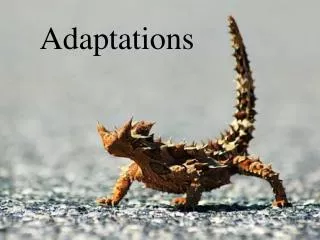
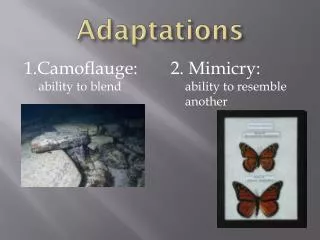
Types of Adaptations • Horns • Antlers • Thorns • Spines • Camouflage • Mimicry • Claws • Sounds • Tentacles • Shell • Odor • Poisons
Structural Adaptation • Ways the body of an organism looks or functions
Behavioral Adaptation • Ways an organism acts • Lung Fish
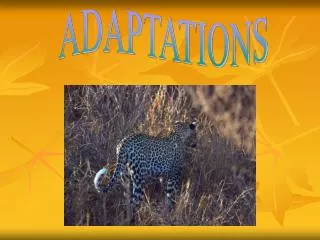
Cheetah Let’s do this one together!
Ant In groups of 4 or 5, write down the structural and behavioral adaptations you notice about your organism.