Download
1 / 15
150 likes | 289 Vues
This guide focuses on understanding exponential growth functions, including their graphs and practical applications like compound interest. You'll learn how to construct and graph exponential growth models, identify key characteristics like asymptotes, and describe behavior as ( x ) approaches infinity. The text includes examples to graph functions and apply compound interest formulas, enhancing your comprehension of exponential growth in various contexts.

E N D
7.1 Exponential Growth Whatyou should learn: Goal 1 Graph and use Exponential Growth functions. p. 478 Write an Exponential Growth model that describes the situation. Goal 2 A2.5.2 7.1 Graph Exponential Growth Functions
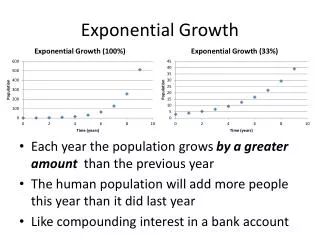
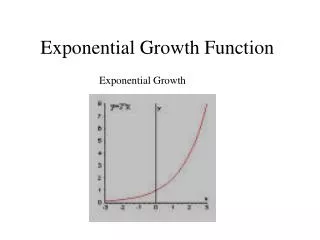
Exponential Function • f(x) = bx where the base b is a positive number other than one. • Graph f(x) = 2x • Note the end behavior • x→∞ f(x)→∞ • x→-∞ f(x)→0 • y=0 is an asymptote
Asymptote • A line that a graph approaches as you move away from the origin The graph gets closer and closer to the line y = 0 ……. But NEVER reaches it 2 raised to any power Will NEVER be zero!! y = 0
Lets look at the activity on p. 479 • This shows of y = a * 2x • Passes thru the point (0,a) (the y intercept is a) • The x-axis is the asymptote of the graph • D is all reals (the Domain) • R is y > 0 if a > 0 and y < 0 if a < 0 • (the Range)
These are true of: • y = abx • If a > 0 & b >1 ……… • The function is an Exponential Growth Function
Example 1 • Graph • Plot (0, ½) and (1, 3/2) • Then, from left to right, draw a curve that begins just above the x-axis, passes thru the 2 points, and moves up to the right
D= all reals R= all reals>0 y = 0 Always mark asymptote!!
Example 2 • Graph y = - (3/2)x • Plot (0, -1) and (1, -3/2) • Connect with a curve • Mark asymptote • D=?? • All reals • R=??? • All reals < 0 y = 0
To graph a general Exponential Function: • y = a bx-h + k • Sketch y = a bx • h = ??? k = ??? • Move your 2 points h units left or right … and k units up or down • Then sketch the graph with the 2 new points.
Example 3 Graph y = 3·2x-1 - 4 • Lightly sketch y = 3·2x • Passes thru (0,3) & (1,6) • h= 1, k= -4 • Move your 2 points to the right 1 and down 4 • AND your asymptote k units (4 units down in this case)
D= all reals R= all reals >-4 y = -4
Now…you try one! • Graph y = 2·3x-2 +1 • State the Domain and Range! • D= all reals • R= all reals >1 y=1
Compound Interest • A=P(1+r/n)nt • P - Initial principal • r – annual rate expressed as a decimal • n – compounded n times a year • t – number of years • A – amount in account after t years
Compound interest example • You deposit $1000 in an account that pays 8% annual interest. • Find the balance after I year if the interest is compounded with the given frequency. • a) annually b) quarterly c) daily A=1000(1+.08/4)4x1 =1000(1.02)4 ≈ $1082.43 A=1000(1+ .08/1)1x1 = 1000(1.08)1 ≈ $1080 A=1000(1+.08/365)365x1 ≈1000(1.000219)365 ≈ $1083.28