Unmasking Human Nature: Shaw's "Caesar and Cleopatra" in Comedy
Bernard Shaw's "Caesar and Cleopatra" serves as a compelling exploration of human behavior, exposing the weaknesses and vices inherent in society. The play navigates the complex relationship between appearance and reality, employing a multifaceted plot filled with obstacles and misunderstandings. While addressing serious themes, it ultimately delivers comic relief rather than catharsis. Shaw, a master of wit, combines elements of high and low comedy to engage and instruct audiences, reflecting on societal norms through the lens of humor.

Unmasking Human Nature: Shaw's "Caesar and Cleopatra" in Comedy
E N D
Presentation Transcript
COMEDY Caesar and Cleopatra By Bernard Shaw
Focuses on people’s social behaviour. • Exposes and unmasks human weaknesses and vices. • Explores the discrepancy between the seeming and the real. • Starts with a problem, ends with its resolution. • Depends on a complicated plot (obstacles, confused identities, misunderstandings). • Instructive by nature and purpose. Comic relief instead of catharsis COMEDY
History of Comedy • Originated in Greece, 4th cent. BC. • First comedies (“Old Comedy”) were bawdy social satires. Aristophanes, “the father of comedy.” • Later, “New Comedy” formed the love-meets-obstacles model.
Main Genres of Comedy • Farce (ex., commedia del arte) • Romantic comedy • Comedy of humours • Comedy of manners These types can be mixed together within one dramatic work.
Types of Comedy • “Low comedy” appeals to baser sense of humour (farce, slapstick comedy). • “High comedy” appeals to intellect (romantic comedy; comedy of humours; comedy of manners).
Brief Historyof English Comedy • Farcical elements in medieval mystery and morality plays (The Second Shepherds’ Play); • Renaissance comedy (Shakespeare, Ben Jonson); • Restoration comedy of manners (William Congreve, Aphra Behn).
Brief Historyof English Comedy • 18th cent. sentimental comedy (Richard Steel) and comedy of manners/humours (Oliver Goldsmith); • 19th cent. comedy of manners (Oscar Wilde); • 20th cent. black/dark/absurd comedy (Samuel Beckett, Harold Pinter).
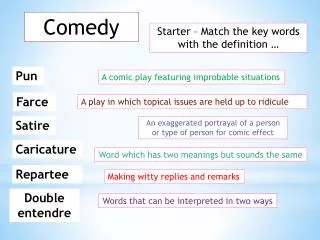
Elements of Comedy • Slapstick humour • Situational humour; qui pro quo. • Satire. • Verbal humour.
George Bernard Shaw (1856-1950) • Irish playwright, writer, critic, journalist, social activist. • The only person to have received both the Nobel prize and an Oscar. • Famous for “Shavian” witticisms. • Co-founded the London School of Economics. • Tried to promote a reform of English spelling.
Caesar and Cleopatraby G.B.Shaw(1898) • The prologues • Language • Role of stage directions • Themes • Characters • Anachronisms • Intertextual references • Humour